1 / 18

Understanding Three-Phase Power Systems: Definitions and Diagrams

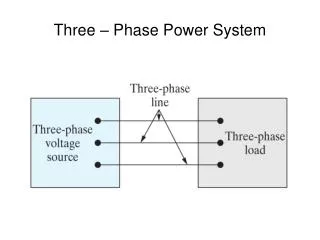
This guide provides a comprehensive overview of three-phase power systems, focusing on key definitions and diagram representations. Learn about the four wires in a three-phase system, the significance of "active" phases A, B, and C, and the role of the neutral wire. The color coding for phases (Red, Black, Blue, and White or Gray for neutral) is explained, along with phasor diagrams for delta-connected and Y-connected sources. Additionally, discover the conduction sequence of three-phase bridge rectifiers and the calculation of average output voltage and current in transformers.
naoko
Télécharger la présentation

Understanding Three-Phase Power Systems: Definitions and Diagrams

An Image/Link below is provided (as is) to download presentation Download Policy: Content on the Website is provided to you AS IS for your information and personal use and may not be sold / licensed / shared on other websites without getting consent from its author. Content is provided to you AS IS for your information and personal use only. Download presentation by click this link. While downloading, if for some reason you are not able to download a presentation, the publisher may have deleted the file from their server. During download, if you can't get a presentation, the file might be deleted by the publisher.

E N D

Presentation Transcript


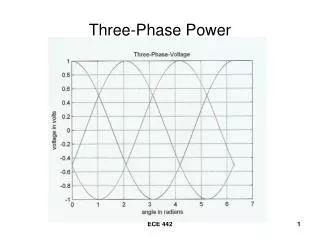
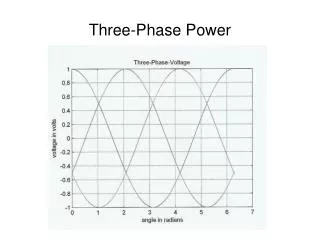
  1. Three-Phase Power

  2. Definitions • 4 wires • 3 “active” phases, A, B, C • 1 “ground”, or “neutral” • Color Code • Phase A Red • Phase B Black • Phase C Blue • Neutral White or Gray

  3. Phasor Diagram

  4. Delta-Connected Sources VLINE = V

  5. Phasor Diagram, VAB as reference

  6. Look at the Currents I = ILINE / 3

  7. Y-Connected Sources

  8. Phasor Diagram with A as reference

  9. Complete Phasor Diagram VLINE = 3V

  10. Look at the Currents I = ILINE

  11. Three-Phase Bridge Rectifier

  12. Conduction Sequence

  13. Average Output Voltage, Vdc

  14. rms Output Voltage

  15. Diode Currents

  16. Transformer Secondary Current

  17. Instantaneous Output Voltage

More Related