Exploring Autism: Monolithic vs. Composite Traits and Their Genetic Correlations
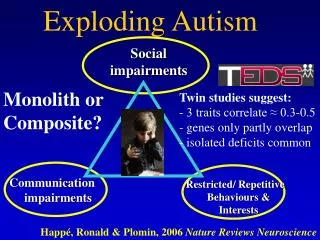
This paper examines the complexity of autism through twin studies, revealing that three key traits correlate moderately (0.3-0.5) and that genetic components only partially overlap. It emphasizes the presence of isolated deficits in social communication, restricted behaviors, and interests, suggesting that no single neurocognitive explanation accounts for autism. The study highlights weak coherence, executive function challenges, and theory of mind issues as significant factors contributing to autism's heterogeneity. It advocates for abandoning the search for one genetic or neural predisposing factor, embracing the multifaceted nature of the disorder.

Exploring Autism: Monolithic vs. Composite Traits and Their Genetic Correlations
E N D
Presentation Transcript
Exploding Autism Social impairments Monolith or Composite? • Twin studies suggest: • 3 traits correlate ≈ 0.3-0.5 • genes only partly overlap • isolated deficits common Communication impairments Restricted/ Repetitive Behaviours & Interests Happé, Ronald & Plomin, 2006 Nature Reviews Neuroscience
Autism: No single neurocognitive explanation Social impairments “Executive functions” “Theory of mind” Problems recognising mental states Problems generating, planning, monitoring Communication impairments Restricted/ Repetitive Behaviours & Interests “weak coherence” Anxiety (Hallett et al, 2009) Savant skills (Vital et al, 2009) Detail-focused cognitive style
Implications of fractionated triad • Abandon search for G/E predisposing to ‘autism’ • Look for contributors to parts of triad • No single factor (genetic, neural, cognitive) specific to ASD • Overlap with other diagnoses predicted • Heterogeneity expected at every level • Single deficits common (10% TEDS); dx, needs? 0.6%