Unveiling the Fury: Exploring Volcanoes and Their Eruptions
500 likes | 593 Vues
Delve into the world of volcanoes – from the formation to eruption types, locations, and case studies of famous volcanic events around the globe. Understand the forces behind repeated eruptions and the impact of magma composition, temperature, and dissolved gases.


Unveiling the Fury: Exploring Volcanoes and Their Eruptions
E N D
Presentation Transcript
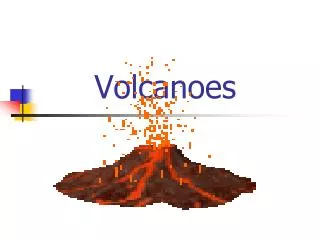
Volcano • Repeated eruptions of lava and pyroclastic material • Often separated by long inactive periods • Often forms a mountain
What causes volcanoes? • Magma forms deep inside Earth • Less dense than rock above it, so slowly forced upward • Magma reaches Earth’s surface and flows through opening called a vent
Volcano Crater • Steep-walled depression around a volcano’s vent • Formed as lava flows out of vent, quickly cools and hardens • A large crater is called a caldera
Form in one of three places Divergent plate boundary Convergent plate boundary Hot spot Where do volcanoes occur?
Divergent Boundaries • Plates separate (move apart) and magma flows up from the rifts. • Can rise above sea level to form islands • Ex: Mid-Atlantic Ridge, Iceland
Plates move together Create subduction zone where several volcanoes may form Ex. Ring of Fire Convergent Boundaries
Hot Spots • Areas away from plate boundaries where magma is forced to the surface • Ex: Hawaii
Factors affecting type of eruption • Viscosity of magma • Magma composition • Magma temperature • Amount of dissolved gases in magma
Viscosity= Resistance to flow The higher the viscosity of magma the greater the eruption Temperature affects viscosity higher temps = lower viscosity Chemical composition of magma also has an effect Higher silica content = greater viscosity
Dissolved Gases Trapped gases provide the force to eject material from the vent 2 main gases- Water vapor and Carbon Dioxide More dissolved gases = greater eruption
Types of Volcanoes • Shield • Lava quietly flows from vent • Mountain covers large area and dome-shaped • Sides gently sloped • Ex: Mauna Loa, Hawaii
Mauna Loa • Earth’s largest volcano
Types of Volcanoes • Cinder Cone • Cinders and rock particles blown into air • Mountain small with steep sides • Ex: Paricutin, Mexico
Types of Volcanoes • Composite • Violent eruption sends up volcanic bombs, cinders and ash • Quiet volcanic flow follows explosion • Alternating layers form mountain • Mountain large and cone-shaped with steep sides • Ex: Mt. St. Helen’s, Washington
Worlds most active volcano: • Kilauea in Hawaii • Most recent series of eruptions 1993 • 1990 destroyed most of Kalapena Gardens, Hawaii
Monserrat • Caribbean Island • Erupted 1997 • 19 killed
Mt. St. Helen’s • May 1980 • 57 killed
Mount Pinatubo • In the Philippines • June 1991, • Almost 900 killed • 27 million metric tons of sulfur dioxide and ash thrown into Earth’s upper atmosphere
Nevado del Ruiz • Armero, Colombia destroyed • Erupted 1985 • 23,000 killed