Stepping into Peer-led Intervention Programs
This presentation delves into the significance of peer-led intervention programs, highlighting their effectiveness in engaging youth in health education. Led by Nari Darst and Janelle See, the session explores current programs at various institutions, roles of peer educators versus staff, and the research-backed advantages for peer health educators. Key takeaways include improved self-awareness, critical thinking, and interpersonal skills among participants. The presentation also outlines the CHOICES program's framework for reducing alcohol-related risks among students, emphasizing the importance of credible, relatable, and non-judgmental educational approaches.

Stepping into Peer-led Intervention Programs
E N D
Presentation Transcript
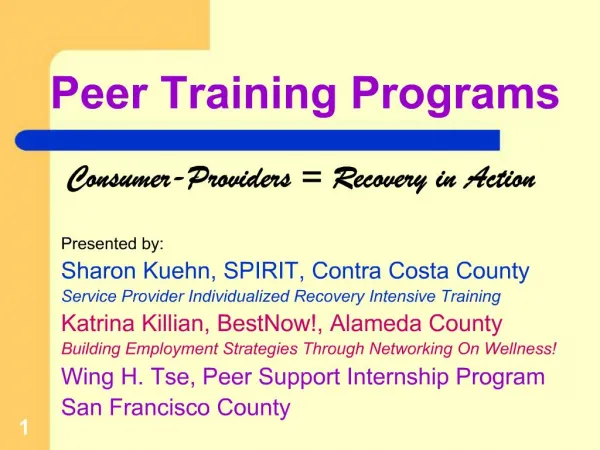
Stepping into Peer-led Intervention Programs Nari Darst, Interim Director, Health Education & PromotionJanelle See, Graduate Assistant, Health Education & Promotion
Peer-led Intervention Programs • What peer-led intervention programs exist at your institution? • What roles do you entrust to your peer educators? What roles do you reserve for full time staff?
Why is Peer Education meaningful? • Youth often find Peer Educators more credible than adult educators • Peer Educators feel more connected to the campus community and are more engaged in campus programming • Peer Educators engage in risk-reducing behaviors more often than their peers • Peer Educators are a source of information for staff about current trends and opinions of the college population • Peer Educators master extensive health information relevant to their own lives • “Tell me and I forget, teach me and I may remember, involve me and I learn.” ― Benjamin Franklin
Research-Proven Benefits to Peer Health Educators (PHEs): PHEs score higher* in the following areas after participation: • intrapersonal development: self-awareness, goal setting, navigating personal values and beliefs, self- confidence, and integrity. • cognitive complexity: examining assumptions, thinking critically, and applying learned concepts to practical problems. • interpersonal communication: active listening, establishing comfort discussing risky behaviors, presenting, role modeling healthy choices for others, and creating meaningful relationships. • knowledge acquisition and application: awareness/ knowledge of campus and community resources, interpreting ideas, evaluating arguments effectively, and developing problem solving skills. *According to the National Peer Education Survey, BACCHUS University
CHOICES • What is CHOICES? • Three-hour intervention workshop for sanctioned students, facilitated exclusively by PHEs • Objective: to reduce the risk of alcohol-related health and impairment problems by providing accurate, unbiased information on personal health risks • Confidential and non-judgmental environment • Encourages self-reflection and motivate students to change • Students are required to complete e-Chug prior to workshop • CSUF Participation: • Fall 2011-Spring 2012: 150 participants • Fall 2012: 47 participants
Activity Effects of Blood Alcohol Concentration (BAC)
Curriculum Development • Modeled on curriculum from Sacramento State • The Change Companies CHOICES Interactive Journal • Script for student facilitators
CHOICES Facilitators • How do we recruit students? • Student Club: Peer Health University Network • Word of mouth/Social Media • Health Sciences practicum experience • Selection Process • Ready: Informal Interview • Previous negative alcohol-related experiences • Set: Training by professionals • Go: Facilitate!
CHOICES Facilitator Training Why is training important? • Provide accurate knowledge • Lay out expectations • Building trust and rapport Training Agenda Day 1: • What is CHOICES? • Leadership Style • Facilitator Role and Expectation • Professional Boundary • Presentation Overview • Curriculum Content • Facilitator Homework Day 2: • Follow up discussion • Mock Presentation
Assessment • Participant Assessment- pre- and post testsdata (2011-2012) • Questions 1-11 on the pre/post-tests are knowledge base where questions 12-19 are self-assessment of student’s views on alcohol consumption. • 150 Students completed assessment during 2011- 2012 academic year. • Over 70% (105) of the students answered 100% of post-test questions correctly. • Most students showed a significant increase of knowledge on the post-tests for questions 1 to 11, but only a small increase (50%) for two questions: • “Alcohol is quickly absorbed into the bloodstream from which of the following organs?” • “For non-tolerant drinkers, at what BAC is the point of diminishing returns?”
Assessment • Participant AssessmentContinued • Positive change in student perceptions of risk-reducing behaviors • “I don’t need to drink alcohol in order to have fun when I socialize.” • “If a friend passes out from drinking, I would know what action to take and do it.” • “I think it’s important to have a plan in mind to limit my drinking before I go out.” • No PHE Facilitator Assessment to date
Assessment Peer Health University Network Leaders Assessment Result • August 2011-May 2012, 11 Leaders • The area of highest increase was in facilitating large groups, where all respondents reported an increase in their ability to create a meeting agenda and speak confidently in front of large groups. • 75% of respondents reported increased in their ability to set personal goals and work towards achieving them.
Implementation Challenges • Funding requirements • Staff – Graduate Assistant • Materials- • CHOICES interactive journals ($2.95 each) • Facilitator Guides • Educational pamphlets • E-CHUG ($975 annually) • “Tell me Something I Don’t Know” video purchased • Workshop supplies • Student facilitator recruitment • Student turnover • Campus partnerships for participant referrals • Annual data analysis & program recommendations • Letting go of control?
Contact Us! NariDarst, Interim Director of Health Education (657) 278-7460ndarst@fullerton.edu Janelle See, G.A. (657) 278-7915janellesee@csu.fullerton.edu