7-segment Numeric display
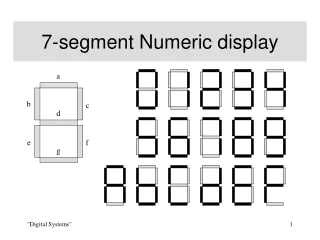
This guide explores the functionality of 7-segment displays and how to utilize Karnaugh maps for simplifying digital circuits. It explains how decimal values (0-9) are represented using 4 binary digits (A, B, C, D) and established combinations. The guide covers how segments are illuminated for specific values and identifies the "don't care" conditions that simplify circuit design. Additionally, it provides insights into the coding system used for each segment along with practical wiring setups. Embrace digital electronics with a clear understanding of these essential components.

7-segment Numeric display
E N D
Presentation Transcript
7-segment Numeric display a b c d e f g
CD AB 00 01 11 10 00 0 1 3 2 01 4 5 7 6 11 12 13 15 14 10 8 9 11 10 Karnaugh (K) Maps • Recall: • To represent decimal values 0-9 requires 4 binary digits Variables ABCD each represent one binary digit electrically Four wires means 16 possible values Four possible values for two binary digits Each entry is one possible combination of ABCD e.g. 6 is ABCD=0110 16 possible values for four binary digits (we only use 0 through 9 for a digital watch)
CD AB 00 01 11 10 00 1 1 1 0 01 1 1 1 1 11 # # # # 10 1 1 # # The F-segment This segment • Goal: • Determine for which values the segment is lit, and for which it isn’t • # is Don’t Care • These don’t matter, since display will never have this value
The F-segments code f-segment CD 00 01 11 10 00 1 1 1 0 01 1 1 1 1 AB 11 # # # # 10 1 1 # # On for every number except 2
The F-segment CD 00 01 11 10 AB 00 1 1 1 0 01 1 1 1 1 11 # # # # 10 1 1 # #
A D B C Wire it up!