
SlideServe
Menu
Préférences
© SlideServe · v2026

Understanding Work, Energy Changes, and Thermodynamics in Chemical Reactions

natane avatar
42 diapositives · 551 Views · Sep 14, 2014

This chapter explores essential concepts in thermodynamics, particularly focusing on the relationships between work (W), heat (q), and internal energy changes (ΔE). It distinguishes between exothermic and endothermic processes, emphasizing how energy transfers shape reactions and their feasibility. Key equations are demonstrated, including the applicability of state functions such as enthalpy (ΔH) and internal energy. Furthermore, the chapter explains calculating changes in energy under constant pressure and varying conditions, offering insights into practical applications in chemistry and energy dynamics.
Understanding Work, Energy Changes, and Thermodynamics in Chemical Reactions - slide 1
01 / 42Understanding Work, Energy Changes, and Thermodynamics in Chemical Reactions
1 / 17

Télécharger la présentation

Understanding Work, Energy Changes, and Thermodynamics in Chemical Reactions
Une image / un lien ci-dessous est fourni (tel quel) pour télécharger la présentation

Politique de téléchargement : le contenu du site vous est fourni TEL QUEL pour votre information et votre usage personnel ; il ne peut être vendu, concédé sous licence ni partagé sur d’autres sites sans l’accord de son auteur.Le contenu vous est fourni TEL QUEL, pour votre information et votre usage personnel uniquement. Téléchargez la présentation en cliquant sur ce lien. Lors du téléchargement, si vous ne parvenez pas à télécharger une présentation, l’éditeur a peut-être supprimé le fichier de son serveur.Pendant le téléchargement, si vous ne parvenez pas à obtenir une présentation, le fichier a peut-être été supprimé par l’éditeur.

F I N

Plus de contenu associé

Transcription de la présentation
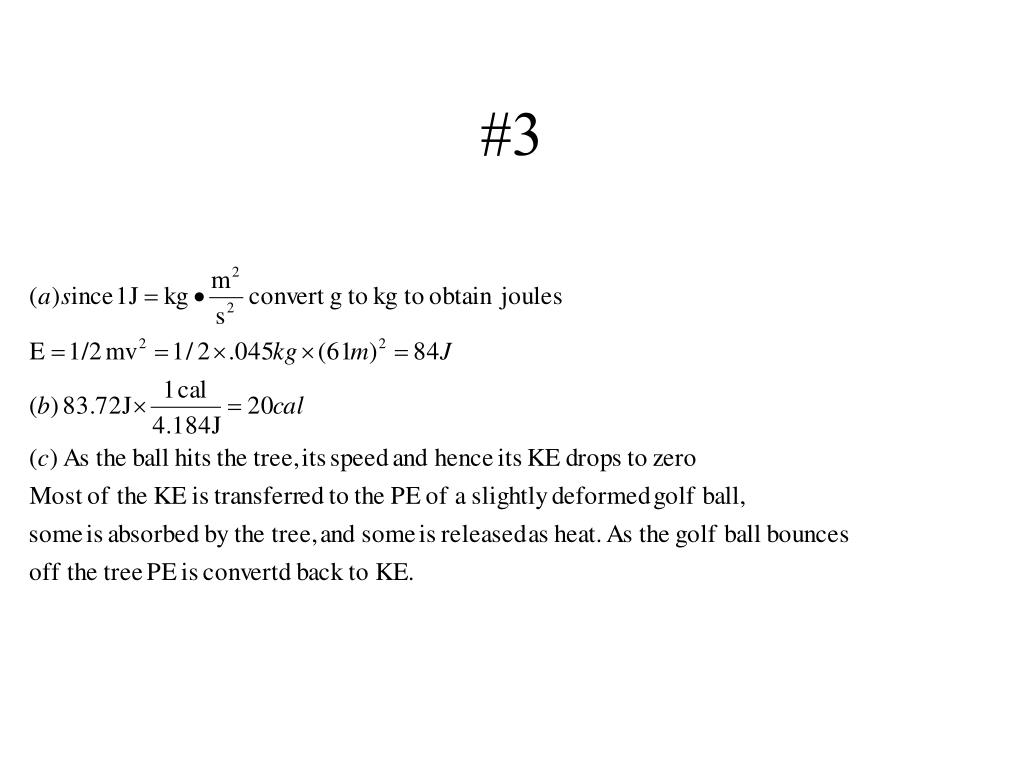
  1. #3

  2. Chapter 5 HW • 5) • Strategy=

  3. #9 • (a) W= Force applied over a distance • (b) W=FD

  4. 15 • (a) q is negative because the system loses heat and w is negative because the system does work. • ΔE = q + w = -113kJ + (-39kJ) = -152kJ. The process is exothermic • (b) ΔE = q + w = +1.62kJ - .847kJ=.75kJ. The process is endothermic. • (c) q is positive because system gains heat and w is negative because the system does work. • ΔE = q + w = +77.5 kJ - 63.5kJ=14kJ. The process is endothermic

  5. 17 • (a) ΔE = q + w since q is neg and w is positive, ΔE depends on the relative magnitudes of each. • (b) since q is positive and w is positive, ΔE is positive • (c) since q is positive and w is negative, ΔE depends on the relative magnitudes of each.

  6. 19 • (a) A state function is a property of a system that depends only on the physical state of the system, not on the route used by the system to get to the current state • (b) Internal energy and Enthalpy are state functions. Work is not a state function • (c) Temp is a state function, regardless of how hot or cold the samples has been, temp only depends on its present condition.

  7. See back of book for 23

  8. 25 • Since ΔH is negative , the reactants 2Cl(g) have a higher enthalpy.

  9. Question 27 • A.) Exothermic (H is negative) B.) C.)

  10. 5.27 D • 2 MgO(s) 2Mg(s) + O2(g) • Reversed reaction so sign on H is reversed

  11. Question 29(a)

  12. Question 29 (b)

  13. Question 29 (c)

  14. 31 • At constant P, ΔE= ΔH-P ΔV. In order to calc ΔE, mor einfo about the condition must be known. For an ideal gas at constant P and T, P ΔV= ΔnRT must be known to calc ΔE from ΔH.

  15. 35 • (a) CO2 (g) + 2H2O (l) → CH3OH (l) + 3/2 O2 (g) ΔH=726.5kJ • (b) 2CH3OH (l) + 3 O2 (g) → 2CO2 (g) + 4H2O (l) ΔH=2(726.5kJ) = -1453kJ • (c) The exothermic reaction is more likely to be favored thermodynamically • (d) Vaporization is endothermic. If the products were gas, less heat energy would be available to release to the surroundings since ti takes energy to convert liquid to gas. It is about 88kJ per 2 moles water. This is not enough to make the overall reaction endothermic.

  16. Question 39

  17. 41

  18. Question 45 (a)

  19. Question 45 (b)

  20. Question 45 (c)

  21. #47 • If a reaction can be described as a series of steps, ΔH for the reaction is the sum of the enthalpy changes for the each step. As long as we can describe a route where we have the ΔH for each step is known, then we can calculate the overall ΔH .

  22. 49 • A→B ΔH =+30kJ • B →C ΔH=+60kJ • Then the overall is 90kJ

  23. 51

  24. 53

  25. Question 59

  26. Question 61 (a)

  27. Question 61 (b)

  28. Question 61 (c) • Hrxn=2Hºf Fe2O3 - 4Hºf FeO - Hºf O2 • 2(822.16kJ) - 4(-271.9kJ) - 2(0) = • -556.7kJ

  29. Question 61 (d)

  30. Question 63 • Hrxn=3Hºf CO2 + 3Hºf H2O - Hºf C3H6O • 3(-393.5kJ) + 3(-285.83kJ) - Hºf C3H6O(l) = -1790kJ • Hºf C3H6O(l)=-248kJ

  31. Question 67 (a & b) • C8H18 +25/2O2 8CO2 + 9H2O • 8C + 9H2  C8H18

  32. Question 67c • Hrxn=8Hºf CO2 (g)+ 9Hºf H2O(g) - Hºf -25/2 Hºf O2(g)- Hºf C8H18(l) • -5069kJ=8(-393.5kJ) + 9(-241.82kJ) -C8H18(l) -25/2(0) = Hºf C8H18(l) =-255kJ

  33. Question 73

  34. Question 75(a) • C3H4(g)+4O2(g)3CO2(g)+ 2H2O(g) • H = 3(-393.5kJ) + 3(-241.82kJ) -(185.4kJ) - 4(0)= -1850kJ/molC3H4

  35. Question 75 a

  36. Question 75b • C3H4(g)+9/2O2(g)  3CO2(g) + 3H2O(g) • H = 3(-393.5kJ) + 3(-241.82kJ) -9/2(0)- (20.4kJ)=-1926kj/molC3H6

  37. 75b

  38. Question 75c • C3H8(g)+5O2(g3CO2(g)+ 4H2O(g) • H = 3(-393.5kJ) + 4(-241.82kJ) -(-103.8kJ) - 5(0) = • -2044kJ/molC3H8

  39. Question 75c

  40. Question 100(a) • Mol Cu=M*L=1.00M*0.0500L=0.0500mol • G=mol *M=0.0500*63.546=3.1773=3.18g Cu • Given there is one mole of Cu per mole of compound (CuSO4)

  41. 100 ( b & c) • CuSO4 + KOH → K2SO4 + Cu(OH) 2 • Cu 2+ SO4 2- +2K 1+ OH 1- Cu(OH)2 + K 1+ SO4 2- • Cu2++2OH-Cu(OH)2

  42. 100(d) • The temp rises so exothermic • Q=(100g)(-6.2ºC)(4.184J/gºC) =-2.6kJ • The reaction is carried out involves .050 mol so on molar basis: • -2.6 kJ/.050mol = -52 kJ/mol