Understanding Pediatric Asthma: Prevalence, Effects, Symptoms, and Management Strategies
280 likes | 411 Vues
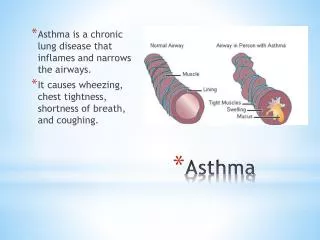
Pediatric asthma is a growing concern, with prevalence rates increasing since 1990. Over 10 million children aged 5-17 were estimated to have asthma, leading to significant school and parental work absences, costing approximately $726 million in lost productivity. Asthma episodes are characterized by wheezing, coughing, and chest tightness, often triggered by allergens, irritants, or emotional stress. Effective management includes preventive medications, inhalers, asthma education, and addressing psychological factors such as stress and family dynamics.


Understanding Pediatric Asthma: Prevalence, Effects, Symptoms, and Management Strategies
E N D
Presentation Transcript
Asthma October 30, 2007
Pediatric Statistics • Prevalence increasing • School absences • Estimated as more than 10 million in 1990 for children between the ages of 5 and 17 • Parental work absences • Estimated to cost $726 million in 1990 • Death rate = 1.9 per 100,000 (1980-89) Weiss, Gergen, & Hodgson (1992)
Characteristics of Asthma • Episodes are variable • Episodes are reversible • Airway hyper-responsiveness
Triggers of Asthma Episodes • Viral respiratory infections • Exercise • Cold air or changes in weather • Irritants • Allergens • Emotional upsets
Signs of Asthma Episode • Wheezing • Chest retractions (especially with infants) • Breathing is faster • Feeling chest tightness (or heaviness) • Coughing • “Status asthmaticus”
Asthma Medications • Two types of medicine • Preventive or Controller = Anti-inflammatory • Rescue = Bronchodilators • Oral steroids • Preferred delivery = Inhalation
Taking Inhaled Medications • Nebulizer (with or without face mask)
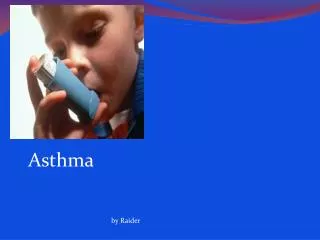
Taking Inhaled Medications • Metered Dose Inhaler (MDI)
Taking Inhaled Medications • Spacer or chamber devices
Preventing an Asthma Episode • Avoid irritants • Control allergens in the environment • Take inhaled bronchodilator PRIOR to exercise • Monitor lung functioning with peak flow meter • Use “preventer” or “controller” medicine REGULARLY
Psychological Factors Affecting Asthma • Stress • Anxiety • Depression
Psychological Factors Affecting Asthma • Family dysfunction • Attachment • Critical mothers • Purcell et al. (1969)
Psychosocial Dysfunction Associated With… • Needing more asthma medications • Having a greater # of hospitalizations • Requiring longer hospitalizations • Dying more frequently from asthma • Not complying with asthma care regimen
Medical Noncompliance • Multiple medications on multiple schedules with varying periods when symptoms are not present • As high as 90% of patients • Negative consequences • Typically “partial” in nature • Assessment of compliance
Psychological Assessment • Interviews, observation, & testing • Parental functioning • Marital status & satisfaction • Employment status & functioning • Social supports & stressors • Understanding of asthma & its treatment
Psychological Assessment • Child functioning • Developmental skills • Quality of peer interactions • School performance • Understanding of asthma & its treatment
Psychological Assessment • Family functioning • Interaction patterns • Routines • Asthma management & family division of responsibility/supervision
When should patients obtain psychotherapy? • Are markedly anxious or depressed • Demonstrate decreased capacity to manage their asthma • Have been erratic in medication use • Have poor perceived control of symptoms
When should patients obtain psychotherapy? • Experience a decline in functioning in school or work • Are in frequent conflict with medical staff • Have made repeated visits to the ER • Family appears dysfunctional, disorganized, or distressed
Treating Medical Noncompliance • Strategies fit into 3 categories • Educational • Organizational • Behavioral
Other Approaches to Treatment • Operant procedures • Positive reinforcement • Satiation • Differential reinforcement of incompatible behavior (DRI) • Response cost • Extinction
Other Behavioral Approaches to Treatment • Systematic desensitization • Biofeedback • Modeling
Other Behavioral Approaches for Non-Adherence • Contracts • Family approaches
Self-Management Programs • Patient education • Training in device techniques • Self-assessment of symptoms • Group & family therapy • Relaxation & stress reduction