Download
1 / 1
10 likes | 120 Vues
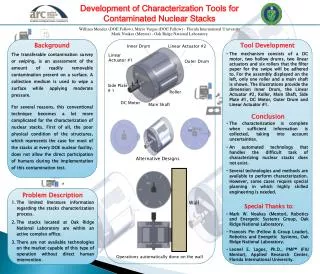
This project introduces innovative tools for characterizing contaminated nuclear stacks, focusing on surfaces where traditional contamination surveys encounter significant challenges. Due to the deteriorated conditions of many DOE facilities, human intervention in conducting contamination assessments is often impractical. Our automated system utilizes a DC motor, linear actuators, and rollers to perform surface swiping and contamination evaluation, addressing the limitations of existing methodologies. This development aims to enhance safety and efficiency in nuclear facility operations, ensuring accurate contamination characterization without direct human involvement.

E N D
Development of Characterization Tools for Contaminated Nuclear Stacks William Mendez (DOE Fellow), Mario Vargas (DOE Fellow) - Florida International University Mark Noakes (Mentor) - Oak Ridge National Laboratory Inner Drum Linear Actuator #2 The transferable contamination survey or swiping, is an assessment of the amount of readily removable contamination present on a surface. A collection medium is used to wipe a surface while applying moderate pressure. For several reasons, this conventional technique becomes a lot more complicated for the characterization of nuclear stacks. First of all, the poor physical condition of the structures, which represents the case for most of the stacks at every DOE nuclear facility, does not allow the direct participation of humans during the implementation of this contamination test. Linear Actuator #1 Outer Drum Side Plate # 1 Roller Tool Development Background • The mechanism consists of a DC motor, two hollow drums, two linear actuators and six rollers that the filter paper for the swipe will be adhered to. For the assembly displayed on the left, only one roller and a main shaft is shown. The illustrations provide the dimension Inner Drum, the Linear Actuator #2, Roller, Main Shaft, Side Plate #1, DC Motor, Outer Drum and Linear Actuator #1. DC Motor Main Shaft Conclusion Problem Description • The characterization is complete when sufficient information is collected, taking into account uncertainties. • An automated technology that handles the difficult task of characterizing nuclear stacks does not exist. • Several technologies and methods are available to perform characterization. However, some cases require special planning in which highly skilled engineering is needed. • The limited literature information regarding the stacks characterization process. • The stacks located at Oak Ridge National Laboratory are within an active complex office. • There are not available technologies on the market capable of this type of operation without direct human intervention. Alternative Designs Wall Special Thanks to: • Mark W. Noakes (Mentor), Robotics and Energetic Systems Group, Oak Ridge National Laboratory. • Francois Pin (Fellow & Group Leader), Robotics and Energetic Systems, Oak Ridge National Laboratory. • Leonel E. Lagos, Ph.D., PMP® (FIU Mentor), Applied Research Center, Florida International University. Operations automatically done on the wall