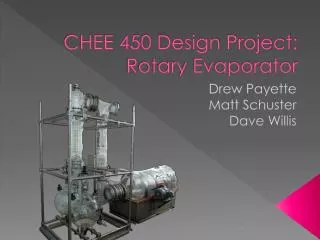
CHEE 450 Design Project: Rotary Evaporator
290 likes | 1.62k Vues
CHEE 450 Design Project: Rotary Evaporator. Drew Payette Matt Schuster Dave Willis. Presentation Outline. Purpose within the Overall Process How Rotary Evaporators Work Design Considerations Purposed Unit and Operating Parameters Alternatives Questions.


CHEE 450 Design Project: Rotary Evaporator
E N D
Presentation Transcript
CHEE 450 Design Project:Rotary Evaporator Drew Payette Matt Schuster Dave Willis
Presentation Outline • Purpose within the Overall Process • How Rotary Evaporators Work • Design Considerations • Purposed Unit and Operating Parameters • Alternatives • Questions
Purpose within the Overall Process • Evaporation of large amounts of unwanted solvent within the process. Figure 1 - Position of rotary evaporator within the insulin production process.
How Rotary Evaporators Work • Use of high vacuum system • Heating bath • Rotating flask causes centrifugal and frictional forces • Solvents move to condenser • Collection flask Figure 2 - Components of a standard rotary evaporator (Lennox)
Design Considerations • SuperPro Data • Batch process • Overall flowrate of 50.43 L/hr • Required evaporation rate of 43.86 L/hr • Main solvent constituents: • Formic Acid (82.77 wt%) • Water for injection (15.03 wt%) • Evaporating flask size • Rate of evaporation of solvent • Operating temperature • Effect of degradation on insulin • Cost of unit
Purposed Unit and Operating Parameters • 100 L Rotary Evaporator • Operating Conditions • Evaporating Flask initial volume is 50 L • Temperature of 40 oC • Evaporation rate is 11.5 L/hr • Four rotary evaporator running simultaneously • Batch time of 3.8 hours before switching flasks
Alternatives • Centrifugal Evaporation • Gel filtration • Freeze drying