Chemistry Review
This review delves into the fundamental components of matter—atoms, electrons, protons, and neutrons. Elements consist of the same type of atoms, while molecules are formed from different atoms, illustrated through examples like NaCl (salt) and C6H12O6 (glucose). The discussion includes how chemical bonds, particularly covalent and ionic bonds, join atoms together. Students explore varying perspectives on chemical bonds, enriching our understanding of how structures form and react in chemistry. Join us in exploring the intricate world of atomic interactions and bonding.

Chemistry Review
E N D
Presentation Transcript
Atoms are the smallest part of matter 3 Particles Electron (e-) outer shell Proton (p+) nucleus Neutron (n0) nucleus
Molecules are made of more than one type of atom NaCl(salt) C6H12O6 (glucose) HCl (hydrochloric acid)
Probe: Is It Made of Molecules? • Bread DNA protons • Cell membrane water atomic nucleus • Oil brain cell worm • Protein egg sugar • Atom flower blood • Bacteria air mushroom • Electrons fruit cell nucleus • Cloud milk seed • Chromosome leaf skin
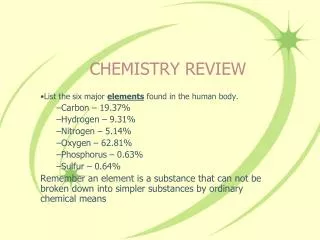
How many elements do you think are in this picture? Earth’s Crust = Al, Fe, Si Water = H, O Air = N, O Person = C, H, N, O, P, S
What is a Chemical Bond? • Three students were discussing their ideas about chemical bonds. This is what they said: • Jane: “I think a chemical bond is produced by a molecule. It is a substance made up of matter that holds atoms together.” • Will: “I think a chemical bond is an attraction between atoms. It is not made up of mater.” • Gabe: “I think a chemical bond is a structural part of an atom that connects it to other atoms? • Who do you most agree with and why?
Chemical Bonds join atoms together • 1. Covalent – when atoms share electrons • Examples: • Water • Glucose • carbon dioxide • oxygen gas • hydrogen gas
2. Ionic Bonding when atomsgain or loseelectrons form compounds
Reactants vs. Products Coefficients Reactants (inputs) Products (outputs)
Model Kits!!!! We will focus on Covalent bonding