Understanding Transformations: Dilations, Translations, and Reflections in Geometry
This comprehensive guide explores the key geometric transformations: dilations, translations, and reflections. Dilations change a figure’s size through enlargements or reductions. Translations involve moving a shape’s coordinates while keeping its size unchanged. Reflections alter a figure’s position by flipping coordinates over an axis. The impact on perimeter and area during these transformations is also discussed, using practical examples to illustrate how dimensions change. Perfect for students learning about geometry!


Understanding Transformations: Dilations, Translations, and Reflections in Geometry
E N D
Presentation Transcript
Transformations By Justin Basa
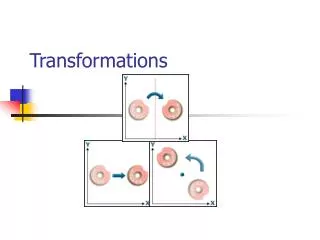
Dilations • Dilation is when you change a figure’s shape. You can either enlarge it or reduce it. • There are two types of dilations: enlargements and reductions.
Translations • Translation is when you change a figure’s coordinates. That means moving it up, down, left, or right.
Reflections • Reflection is when you change one of the figure’s coordinates into its opposite. • If you’re reflecting over the x-axis, you make the figure’s y-coordinate into its opposite. • If you’re reflecting over the y-axis, you make the figure’s x-coordinate into its opposite. • For example, if the figure’s coordinates are (1,2) and you’re reflecting over the x-axis, you make 2 negative. The new coordinates will be (1,-2). If you’re reflecting over the y-axis, make the 1 negative. The new coordinates will be (-1,2).
Enlargements • Enlargements are a type of dilation. If you dilate a figure and the new one is larger than the original one, then the dilation is an enlargement. • Scale factors greater than one will produce an enlargement. If you’re scale factor is anything less than one, than your dilation is not an enlargement.
Reductions • Reductions are a type of dilation. If you dilate a figure and the new one is smaller than the original one, then the dilation is a reduction. • Scale factors less than one produce a reduction. If your scale factor is greater than one, then your dilation is not a reduction.
PerimeterandArea • When you change a two-dimensional figure’s dimensions, you affect the perimeter and area. • For example, you have a square with its sides being one inch long. You dilate it to a square with two inches long. The original’s area is one inch square. The new figure’s area is four inches squared. The area is now four times larger. • It’s the same for perimeter. You have a square with one inch sides. You dilate it to a figure with two inch sides. The original’s perimeter is four inches. The new figure’s perimeter is eight inches. The perimeter is now two times larger.