
SlideServe
Menu
Préférences
© SlideServe · v2026

CONDUCTION OF NERVE IMPULSES

nedaa avatar
8 diapositives · 5.4K Views · Sep 10, 2014

CONDUCTION OF NERVE IMPULSES. *Nerve impulse is a sum of mechanical(injury) ,chemical(heat,cold) and electrical stimulus. *A minimum strength of stimulus called threshold stimulus ---minus 55 tominus 60mv (resting potential—minus70mv).
CONDUCTION OF NERVE IMPULSES - slide 1
01 / 8CONDUCTION OF NERVE IMPULSES
1 / 17

Télécharger la présentation

CONDUCTION OF NERVE IMPULSES
Une image / un lien ci-dessous est fourni (tel quel) pour télécharger la présentation

Politique de téléchargement : le contenu du site vous est fourni TEL QUEL pour votre information et votre usage personnel ; il ne peut être vendu, concédé sous licence ni partagé sur d’autres sites sans l’accord de son auteur.Le contenu vous est fourni TEL QUEL, pour votre information et votre usage personnel uniquement. Téléchargez la présentation en cliquant sur ce lien. Lors du téléchargement, si vous ne parvenez pas à télécharger une présentation, l’éditeur a peut-être supprimé le fichier de son serveur.Pendant le téléchargement, si vous ne parvenez pas à obtenir une présentation, le fichier a peut-être été supprimé par l’éditeur.

F I N

Plus de contenu associé

Transcription de la présentation
  1. CONDUCTION OF NERVE IMPULSES

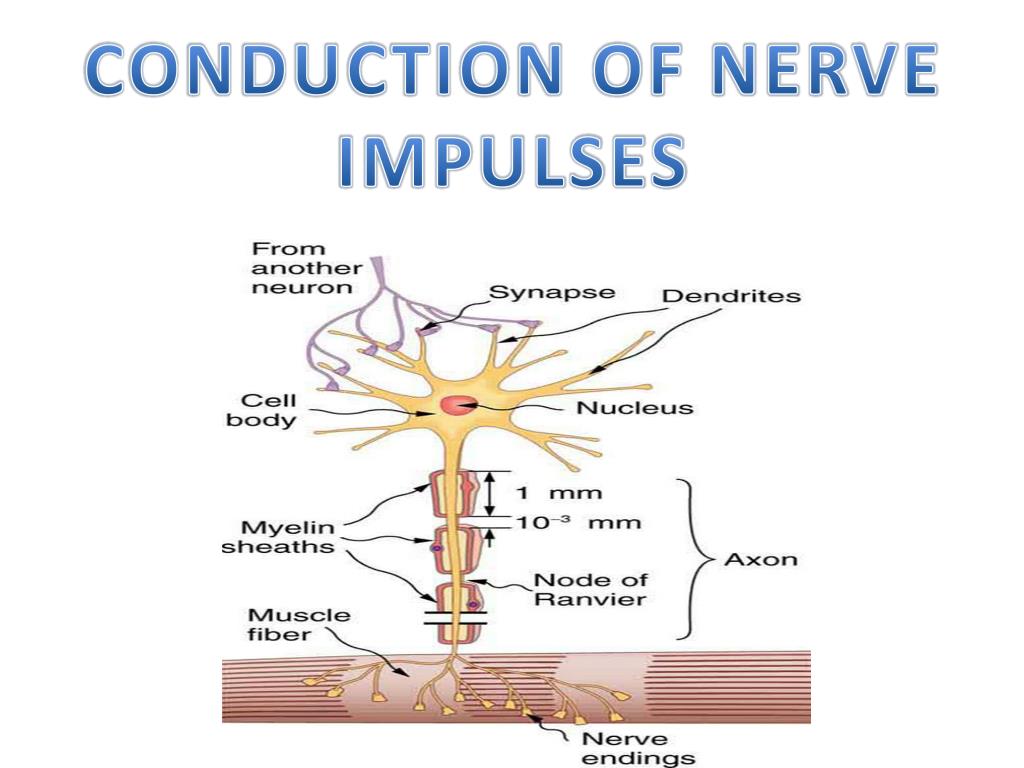
  2. *Nerve impulse is a sum of mechanical(injury) ,chemical(heat,cold) and electrical stimulus. • *A minimum strength of stimulus called threshold stimulus ---minus 55 tominus • 60mv (resting potential—minus70mv). • *When membrane is at resting state extracellular fluid is with about ten times of Na+ than inside the membrane ,while intracellular fluid is about 30-40 times of K+ than in extra cellular fluid ,intracellular fluid more negative due to negatively charged proteins and outside is positively charged .It is less permeable to Na than K

  3. *Mechanism of conduction of nerve impulse (1) Generation of nerve impulse—When membrane potential is about -50mv,Na channels get activated –membrane is 500to5000 times more permeale toNa+ than K+ .therefore inside is positive and outside is negative.This reversible of polarity is called depolarization of membrane .It lasts for 1s/1000of second. This action potential travels as a wave of depolarization along the length of a nerve fibre called nerve impulse. (2) Repolarisation of membrane----Now the membrane is more permeable to K+ than Na+ because of closing of Na+ channels and opening of K+ channels.Soon Membrane regains its polarity—outside is positive and inside is negativentsve called Repolarisation of membrane .It occurs about 0.5 seconds. The whole process of depoarisation and repolarisation takes 1to5 seconds.

  4. (3)Saltatory conduction of nerve impulse –In a non myelinated nerve fibres ,these action potential flows as a wave but in a myelinated fibres (cranial and spinal nerves) ,the medullary sheath is impermeable to ions so prevents ion exchanges and depolarization of nerve along the length . The ion exchange and depolarization occurs only at some points called node of Ranvier. When it reaches N.O.D.,It opens Na+channels and action potential is generated and conducted from node to node in a jumping manner.It is 20times faster than non myelinated fiber and less a enegy is consumed.

  5. Transmission of Nerve Impulse---- The Synapse ---It is area of functional contact between one neuron and another . Stucture of Synapse A bulbous expansion of nerve terminal called presynaptic knob lying close to dendrites .The cytoplasm knob have vesicles ,which contain neurotransmitters ,responsible for transmission of nerve impulse across the synapse ..The membrane of synaptic knob called presynaptic membrane and the membrane of dendrite called post synaptic membrane .These membrane are separated by a gap called synaptic cleft .The post synaptic membrane contain large protein molecules which act as receptor sites for neuro transmitters

  6. When an impulse arrives at a presynaptic knob , calcium ions from the synaptic cleft enter the cytoplasm of the presynaptic lnob. • The calcium ions cause the movement of the synaptic vesicles to the surface of the knob.The synaptic vesicles are fused with the presynaptic membrane and get ruptured (exocytosis) to discharge their contents (neurotransmitter) into the synaptic cleft.

  7. The neurotransmitter of the synaptic cleft binds with protein receptor molecules on the post synaptic membrane. This binding action changes the membrane potential of the postsynaptic membrane, opening channels in the membrane an allowing sodium ions to enter the cell. This causes the depolarization and generation of action potential in the post-synaptic membrane . Thus the impulse is transferred to the next neuron. • Having produced a change in the permeability of the postsynaptic membrane the neurotransmitter is immediately lost from the synaptic cleft. In the case of cholinergic synapses , acetylcholine(Ach) is hydrolysed by an enzyme acetycholinesterase(Ache) which is present in high concentration at the synapse.