Epitaxial Growth of SiC Nanocrystals on Silicon: Mechanisms and Characterization
This study investigates the epitaxial growth of silicon carbide (SiC) on silicon (Si) substrates, focusing on the formation of SiC nanocrystals at the SiO2/Si interface. The growth process involved thermal treatment in carbon monoxide (CO) and examined the quality of the formed SiC layers. Results show that nanocrystals epitaxially aligned with the Si matrix exhibit high density and good orientation, with minimal defects such as voids and micropipes. The findings suggest that improved SiC layer quality can enhance semiconductor applications.

Epitaxial Growth of SiC Nanocrystals on Silicon: Mechanisms and Characterization
E N D
Presentation Transcript
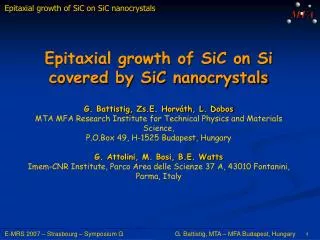
Epitaxial growth of SiC on Si covered by SiC nanocrystals G. Battistig, Zs.E. Horváth, L. DobosMTA MFA Research Institute for Technical Physics and Materials Science,P.O.Box 49, H-1525 Budapest, HungaryG. Attolini, M. Bosi, B.E. WattsImem-CNR Institute, Parco Area delle Scienze 37 A, 43010 Fontanini, Parma, Italy
Motivation SiC epitaxy on Si : poor crystalline quality, important stress inside the 3C-SiClayers, presence of voids at the 3C-SiC/Si interface SiC nanocrystals at SiO2/Si interface The growth process Investigation of the SiC nanocrystals SiC epitaxy Outline
Growth of the SiC nanocrystals • (100) Silicon with thermally grown SiO2 • Quartz furnace • 100% CO • Temperature above 900°C • 30min - 8h
The carbon accumulation at the interface is independent from the thickness of the oxide layer fast diffusion Above 900°C from the 3 steps of the carbon transport (CO entering the oxide, diffusion through the SiO2, reaction in the Si) the reaction at the interfacesupposed tocontrolthe mechanism Growth mechanism 2CO + 2 SiO22SiO2:Ci,Oi [Köhler, 2001]+ 7eV 2 (CO)g + 2 <SiO2>s 2 <SiC>s + 3 (O2)g+ 8eV 4 (CO)g+ 6 <Si>s 4 <SiC>s+ 2 (SiO2)sexoterm, - 6 eV
TEM measurements 3C-SiC crystallites grow • epitaxially with the Si matrix (001) Si || (001) SiC and [100] Si || [100] SiC • no voids at the SiC/Si interface • faster lateral growth
SEM images of the (100) plane 100 nm SiO2 / Si 1150°C - 100% CO - 90 mins plan view images after removing the protective 100 nm thick SiO2 layer with HF 100 nm SiO2 / Si 1150°C - 100% CO - 8 hours
The SiC/Si interface SiO2 SiC Si Cross sectional TEM image of a (100) Si/SiO2 system annealed in 100% CO, 1 Bar at 1100oC for 2hrs
SiC Si SiC SiO2 Si SiC (100) Si
SiC epitaxy Horizontal Vapour Phase Epitaxy - reactor at atmospheric pressure, using propane and silane diluted in hydrogen, induction heating with a growth temperature of 1200°C The growth process:- thermal treatment (H2) - carbonisation (H2+C3H8)- SiC growth(H2+C3H8+SiH4) - Etch (H2)
Microscopic structure of epi-SiC • #1: 90 mins nc-SiC – low density • polycrystalline 3C-SiC is formed (X-ray diffraction) • well oriented crystals (e-diffraction) • ~ 70 nm SiC, rough surface and interface • Void – micropipe formation SiC Si
#2: 8 h nc-SiC – high density • polycrystalline 3C-SiC layer • well oriented crystals (e-diffraction) • ~ 70 nm SiC, smooth surface and interface • NO pit - void – micropipe formation SiC Si
Conclusion • 3C-SiC nanocrystals formed at SiO2/Si interface • Seeds for SiC epitaxy • High nc-SiC density – No pits, voids, micropipes • Improvement of the quality of SiC layer is needed • Possible lateral structuring