Dynamic Energy Budget Theory: Metabolism, Assimilation, and Growth in DEB Organisms
210 likes | 345 Vues
This document explores the Dynamic Energy Budget (DEB) theory, emphasizing the metabolism of individual organisms, including assimilation, dissipation, and growth processes. It discusses state variables, fixed allocation rules, and priority maintenance rules affecting energy flows. Theoretical exercises encourage understanding of energy balances, stoichiometric relationships, and the dynamics of reserve density in relation to environmental variables. Contributions from renowned experts highlight the theoretical framework and practical applications of DEB in ecological and biological research.


Dynamic Energy Budget Theory: Metabolism, Assimilation, and Growth in DEB Organisms
E N D
Presentation Transcript
DynamicEnergy Budget Theory - I Tânia Sousa withcontributionsfrom : Bas Kooijman
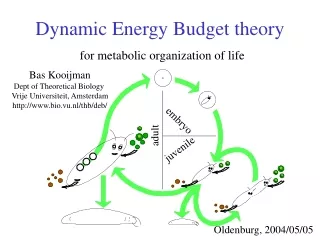
A DEB organismAssimilation, dissipationandgrowth • Metabolism in a DEB individual. • Rectangles are state variables • Arrows are flows of foodJXA, reserveJEA, JEC, JEM, JET, JEG, JER, JEJor structureJVG. • Circles are processes • The full square is a fixed allocation rule (the kappa rule) • The full circles are the priority maintenance rule. Feeding ME- Reserve Mobilisation Assimilation Offspring MER MaturityMaintenance Reproduction Growth SomaticMaintenance Maturation MH - Maturity MV - Structure
3 types of aggregated chemical transformations • Assimilation: X(substrate)+M E(reserve) + M + P • linked to surface area • Dissipation: E(reserve) +M M • somatic maintenance: linked to surface area & structural volume • maturity maintenance: linked to maturity • maturation or reproduction overheads • Growth: E(reserve)+M V(structure) + M • Compounds: • Organic compounds: V, E, X and P • Mineral compounds: CO2, H2O, O2 and Nwaste
Exercises • Identify in theseequationsyXE, yPEandyEV. • Constraintsonthe yield coeficients • Degreesoffreedom
Exercises • Identify in theseequationsyXE, yPEandyEV. • Constraintsonthe yield coeficients • Degreesoffreedom • Obtaintheaggregatedchemicalreactions for assimilation, dissipationandgrowthconsideringthatthechemicalcompositions are: food CH1.8O0.5N0.2, reserve CH2O0.5N0.15, faeces CH1.8O0.5N0.15,structure CH1.8O0.5N0.15and NH3.
Exercises • Identify in theseequationsyXE, yPEandyEV. • Constraintsonthe yield coeficients • Degreesoffreedom • Obtaintheaggregatedchemicalreactions for assimilation, dissipationandgrowthconsideringthatthechemicalcompositions are: food CH1.8O0.5N0.2, reserve CH2O0.5N0.15, faeces CH1.8O0.5N0.15,structure CH1.8O0.5N0.15and NH3. • Howwouldyouobtaintheaggregatechemicaltransformation?
Exercises • What istherelationshipbetweentheseequationsand, ,,, , and . • Considering for thejuvenile
Exercises • What istherelationshipbetweentheseequationsand, ,,, , and . • Compute the total consumptionof O2. • Writeit as a functionof, and .
Exercises • What istherelationshipbetweentheseequationsand, , , , , and . • Compute the total consumptionof O2. • Writeit as a functionof, and . • Thestoichiometryoftheaggregatechemicaltransformationthatdescribestheorganismhas 3 degreesoffreedom: anyflowproducedorconsumed in theorganismis a weightedaverageofanythreeotherflows
Exercises • Write theenergy balance for eachchemical reactor (assimilation, dissipationandgrowth)
Exercises • Write theenergy balance for eachchemical reactor (assimilation, dissipationandgrowth) • Compute the total metabolicheatproductionas a function of , and .
Exercises • Write theenergy balance for eachchemical reactor (assimilation, dissipationandgrowth) • Compute the total metabolicheatproductionas a function of , and . • Iftheorganismtemperatureisconstantthenthemetabolicheat must beequal to theheatreleased • Indirectcalorimetry (estimatingheatproductionwithoutmeasuringit): Dissipatingheatisweighted sum ofthreemassflows: CO2, O2andnitrogeneouswaste (Lavoisier in the XVIII century).
Dissipating heat Steam from a heap of moist Prunus serotina litter illustrates metabolic heat production by fungi
Exercises • Obtain an expression for the dynamics of the reserve density mEusingtheequations for thedynamicsof MEand MVandthefollowingequations:
Exercises • Obtain an expression for the dynamics of the reserve density mE • Set dmE/dt=0 (weakhomeostasis). • WhatisthemaximumvalueofmE?
Exercises • Obtain an expression for the dynamics of the reserve density mE • Set dmE/dt=0 (weakhomeostasis). • WhatisthemaximumvalueofmE? • Can youunderstandthemeaning? • Whatisthevalue for mEin weakhomeostasis? -maximumreserve density
Exercises • Obtain an expression for the dynamics of the reserve density mE • Set dmE/dt=0 (weakhomeostasis). • WhatisthemaximumvalueofmE? • Can youunderstandthemeaning? • Whatisthevalue for mEin weakhomeostasis? -maximumreserve density
Exercises • Obtain an expression for the dynamics of the reserve density mE • Set dmE/dt=0 (weakhomeostasis). • WhatisthemaximumvalueofmE? • Can youunderstandthemeaning? • Rewrite usingmEm. -maximumreserve density
Exercises • Obtain an expression for the dynamics of the reserve density mE • Set dmE/dt=0 (weakhomeostasis). • WhatisthemaximumvalueofmE? • Can youunderstandthemeaning? • RewriteusingmEm. Whatisthemeaningof? -maximumreserve density
Exercises • Obtain an expression for the dynamics of the reserve density mE • Set dmE/dt=0 (weakhomeostasis). • WhatisthemaximumvalueofmE? • Can youunderstandthemeaning? • Rewrite usingmEm. Whatisthemeaningof? -maximumreserve density - maximumlength -maximumreserve density