Download

1 / 15
160 likes | 282 Vues
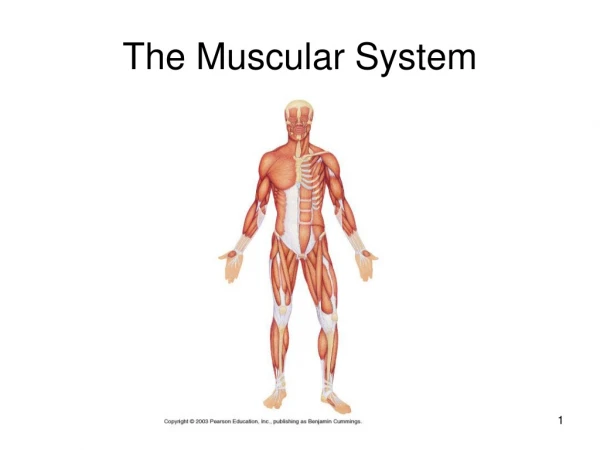
The muscular system comprises three types of muscle tissue: skeletal, smooth, and cardiac. Skeletal muscles are striated and under voluntary control, enabling movement and posture maintenance. Cardiac muscle, found exclusively in the heart, is also striated but involuntary. Smooth muscle, which is non-striated, controls the walls of hollow organs. Each muscle is composed of fibers organized into myofibrils, with contraction facilitated by the sliding filament theory, involving myosin and actin. This system plays a crucial role in movement, stability, and body temperature regulation.

E N D
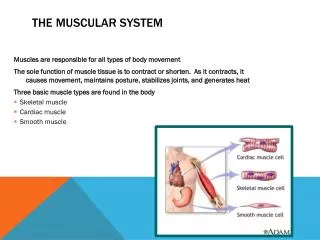
MUSCULAR SYSTEM • Types of Muscle Tissue: Skeletal, Smooth, and Cardiac • Skeletal, aka “striated” • voluntary – attached to bones and under conscious, willful control. • Has the ability to contract (shorten) and thereby bring about movement
Cardiac Muscle • Found only in the heart • Striated • Involuntary • Cells connected by intercalated disks
Smooth Muscle • Not striated • Involuntary • Walls of hollow organs such as: • Stomach, urinary bladder, respiratory passages • Arranged in sheets/layers
Muscle Functions • Producing Movement • Maintaining Posture • Stabilizing Joints • Generating Heat • Maintaining body temperature
Muscle and Muscle Fiber Structure: • A muscle is composed of many muscle fibers (muscle fiber = muscle cell). • The individual muscles are separated from each other and held in place by a covering called the FASCIA. • This fascia also forms TENDONS connecting muscles to bones.
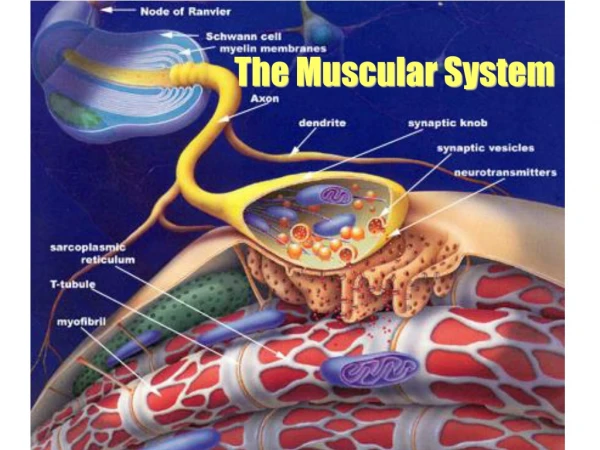
The muscle fiber membrane is called the SARCOLEMMA and the cytoplasm is called the SARCOPLASM. • Within the sarcoplasm are many parallel fibers known as MYOFIBRILS.
Each myofibril is made of many protein filaments called MYOFILAMENTS. There are two types: • MYOSIN – thick filaments • ACTIN – thin filaments
Actin and Myosin filaments are arranged in an overlapping pattern of light (“I” bands) and dark (“A” bands). • In the middle of each “I” band is a line called a “Z” line. • The section of a myofibril from one Z-line to the next Z-line is called a SARCOMERE. • The arrangement of these sarcomeres next to each other produces the STRIATIONS of the skeletal muscle fibers.
How do muscles contract? • Stimulated by nerve impulses to contract • Sliding Filament Theory • Muscle cell becomes excited – action potential • Flood of calcium • Myosin heads bind to thin filaments • Form “cross bridges” • Heads bend and pull thin filaments together • Muscle shortens – contracting! • Video animation of muscle contraction