Endocrine System
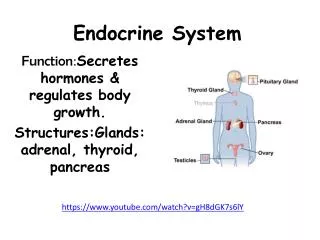
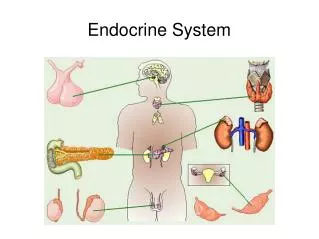
The endocrine system consists of various glands that secrete hormones directly into the bloodstream, acting as chemical messengers. Key glands include the hypothalamus, pituitary, thyroid, parathyroid, adrenal glands, and gonads (ovaries and testes). Hormonal control is largely managed through feedback mechanisms, primarily negative feedback, while some hormones are released in response to nervous control. Each gland has specific roles, such as metabolism regulation by the thyroid or stress response coordination via adrenal hormones.

Endocrine System
E N D
Presentation Transcript
ENDOCRINE GLANDS • • Secrete hormones directly into bloodstream • • Ductless • EXOCRINE GLANDS • secrete substances through a duct (sweat, salivary, lacrimal and pancreas)
Function of the Endocrine System • – to secrete hormones – chemical messengers that coordinate and direct target cells and organs.
Hormonal Control • NEGATIVE FEEDBACK • • Drop in hormone level triggers a chain • reaction to increase secretion, for example • 1. Blood level of hormone falls • 2. Brain gets message and sends out • hormone to stimulate gland • 3. Gland stimulates more hormone • 4. When blood levels of hormone increase, • the brain hormones stop
Nervous Control – in some cases, sympathetic • nervous system causes direct release of hormone • from gland (for example, when stress causes the • adrenal medulla to secrete adrenalin)
Hormone Transport in Blood • Water-soluble hormones are transported dissolved in blood plasma. • Others circulate in blood, bound to plasma proteins. • The free hormone diffuses across capillary walls to encounter its target cells.
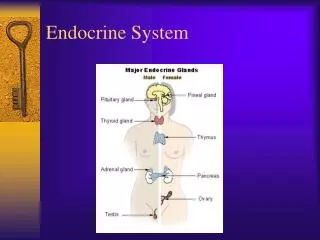
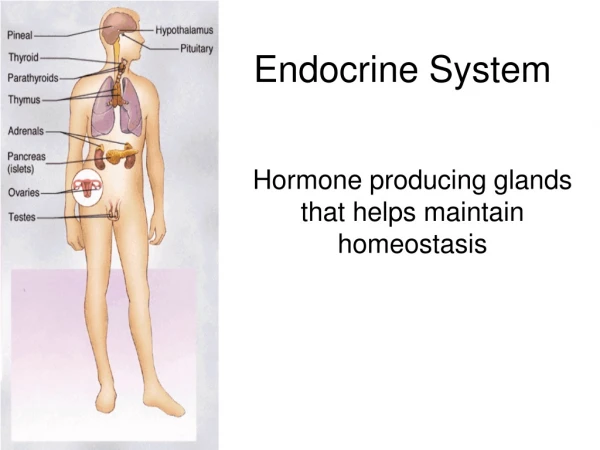
The Endocrine System • Consists of several glands located in various parts of the body • Specific Glands • Hypothalamus • Pituitary • Thyroid • Parathyroid • Adrenal • Kidneys • Pancreatic Islets • Ovaries • Testes
Hypothalamus • Produces several releasing and inhibiting factors that stimulate or inhibit anterior pituitary’s secretion of hormones. • Produces hormones that are stored in and released from posterior pituitary.
Hypothalamus • Also responsible for: • Regulation of water balance • Esophageal swallowing • Body temperature regulation (shivering) • Food/water intake (appetite) • Sleep-wake cycle • Autonomic functions
PITUITARY GLAND • • Tiny structure the size of a grape • • Located at the base of the brain • • Connected to the hypothalamus • • Divided into anterior and posterior lobes • • The “Master Gland”
Pituitary Gland • Two areas • Anterior Pituitary • Posterior Pituitary • Structurally, functionally different
Anterior Pituitary Lobe • • GROWTH HORMONE –GH(SOMATOTROPIN) - responsible for growth and development • • PROLACTIN – develops breast tissue, • stimulates production of milk after childbirth • • THYROID-STIMULATING HORMONE – TSH - • stimulates thyroxine • • ADRENOCORTICOTROPIC HORMONE (ACTH) – stimulates adrenal cortex
Anterior Pituitary Lobe (cont) • • FOLLICLE-STIMULATING HORMONE (FSH) - • stimulates growth of graafian follicle andproduction of estrogen in females, sperm in males • • LUTEINIZING HORMONE – LH – stimulates • ovulation and formation of corpus luteum, which produces progesterone in females
Posterior Pituitary Lobe • • VASOPRESSIN – converts to ADH • (antidiuretic hormone) in the bloodstream, acts on kidney to concentrate urine and preserve H2O in the body • • OXYTOCIN – released during childbirth • causing contractions of the uterus
THYROID GLAND • • Butterfly-shaped mass of tissue • • On either side of larynx, over trachea • • H-shaped
Thyroid Hormones • • Main hormone – THYROXINE – is controlled • by the secretion of TSH • • Thyroxine controls the rate of metabolism • • CALCITONIN – controls calcium ion concentration in the body, prevents hypercalcemia
PARATHYROID GLANDS • • Four glands, each the size of a grain of rice • • Attached to posterior thyroid • • Produce PARATHORMONE which helps • control blood calcium level, prevents • hypocalcemia
THYMUS • • Endocrine gland and lymphatic organ • • Located behind the sternum, above and in • front of the heart • • Begins to disappear at puberty
ADRENAL GLANDS • • Located on top of each kidney • • Adrenal cortex secretes hormones known at • corticoids – they are anti-inflammatory • • They are: mineralcorticoids, glucocorticoids, • and sex hormones
Adrenal Hormones • • ANDROGENS are male sex hormones • • Adrenal medulla secretes epinephrine • (adrenalin) and norepinephrine • • ADRENALIN is a powerful cardiac stimulent – “fight or flight” hormones that prepare the body for an emergency situation
GONADS • • Ovary in female • • Testes in male • • Estrogen – development of female reproductive organs, secondary sex characteristics • • Progesterone – plays a part in the menstrual • cycle • • Testosterone – male reproductive organs and • secondary sex characteristics
PANCREAS • • Located behind the stomach • • Endocrine and exocrine functions • • Involved in production of INSULIN by ISLETS • OF LANGERHANS • • Insulin – promotes utilization of glucose by the • cells, fatty acid and amino acid transport, and • facilitates protein synthesis
Other Hormones • PROSTAGLANDINS – tissue hormones, can • cause constriction of blood vessels, muscle • contractions. Can be used to induce labor.