Dynamics of Edge Plasma Physics: ELMs, Pedestal Formation, and the Role of Lithium
This study delves into crucial aspects of edge plasma physics, focusing on the physics behind Edge Localized Modes (ELMs) and pedestal formation. It explores how lithium (Li) contributes to ELM suppression and analyzes the role of neutral particles. Additionally, the work aims to develop testable models for predicting pedestal height and width, utilizing the EPED framework. It examines scrape-off layer (SOL) width, turbulence effects, and interactions between various plasma phenomena, including flow dynamics and divertor configurations, to enhance predictive modeling capabilities.

Dynamics of Edge Plasma Physics: ELMs, Pedestal Formation, and the Role of Lithium
E N D
Presentation Transcript
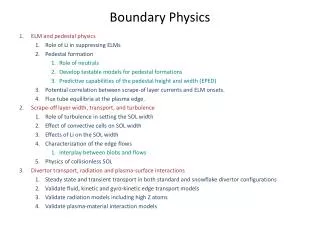
Boundary Physics • ELM and pedestal physics • Role of Li in suppressing ELMs • Pedestal formation • Role of neutrals • Develop testable models for pedestal formations • Predictive capabilities of the pedestal height and width (EPED) • Potential correlation between scrape-of layer currents and ELM onsets. • Flux tube equilibria at the plasma edge. • Scrape-off layer width, transport, and turbulence • Role of turbulence in setting the SOL width • Effect of convective cells on SOL width • Effects of Li on the SOL width • Characterization of the edge flows • Interplay between blobs and flows • Physics of collisionless SOL • Divertortransport, radiation and plasma-surface interactions • Steady state and transient transport in both standard and snowflake divertor configurations • Validate fluid, kinetic and gyro-kinetic edge transport models • Validate radiation models including high Z atoms • Validate plasma-material interaction models