Download
1 / 45
450 likes | 562 Vues
The "Understanding and Managing Sweetness Conference," held in New Delhi, India, on September 17, 2009, addressed the critical issue of growing obesity rates and chronic diseases globally. Keynote speaker Dr. John P. Foreyt discussed the importance of managing calorie balance, emphasizing that it is not just sugar but an overall excess of calories that contributes to obesity. The conference aimed to clarify misconceptions surrounding sweetness and health and promote a well-balanced diet as a key to healthy living, alongside proactive strategies for dietary management.

E N D
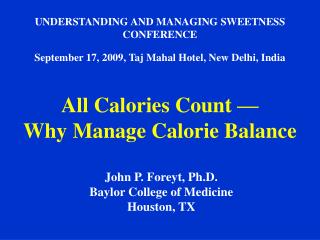
UNDERSTANDING AND MANAGING SWEETNESS CONFERENCE September 17, 2009, Taj Mahal Hotel, New Delhi, India All Calories Count — Why Manage Calorie Balance John P. Foreyt, Ph.D. Baylor College of Medicine Houston, TX
Sweetness, Obesity & Health • Public health officials worldwide are frustrated that consumers do not follow dietary guidelines to promote good health • Private health practitioners and providers have similar frustrations • Governments predict steep increases in the rates of chronic diseases, putting serious strains on the world’s healthcare systems and on national budgets
PREVALENCE (%) OF OVERWEIGHT (BMI > 25) AMONG ADULTS MALEFEMALE UNITED STATES 71 62 AUSTRALIA 68 52 NEW ZEALAND 62 50 ENGLAND 65 56 GERMANY 75 59 IOTF Website 2005; Ogden et al, JAMA 2006
PREVALENCE (%) OF OVERWEIGHT (BMI > 25) AMONG ADULTS MALEFEMALE FINLAND 68 52 ICELAND 64 54 SWEDEN 51 42 IOTF Website, Updated March 16, 2005
PREVALENCE (%) OF OVERWEIGHT (BMI > 25) AMONG ADULTS MALEFEMALE CROATIA 79 50 CZECH REPUBLIC 73 58 HUNGARY 63 49 IOTF Website, Updated March 16, 2005
PREVALENCE (%) OF OVERWEIGHT (BMI > 25) AMONG ADULTS MALEFEMALE MEXICO 67 72 ARGENTINA 67 55 CHILE 60 60 BRAZIL 38 39
PREVALENCE OF OVERWEIGHT & OBESITY IN BEIJING CHINESE MEN (1998) Overweight (%) Obese (%) (BMI > 24-27.9) (BMI > 28) Beijing • Workers 51 7 • Farmers 50 8 • Urban Residents 52 7 Wu et al, 2002
PACIFIC ISLANDERS ARE THE MOST OBESE (BMI > 30)IN THE WORLD • 70% Tongan Women Obese • 63% Samoan Women Obese • 79% Nauru Women Obese IOTF Website, Updated March 16, 2005
PREVALENCE (%) OF OVERWEIGHT (BMI>25) AMONG U.S. ADULTS % 19801 46.0 19901 56.0 20001 64.5 20102 73.5 20202 82.5 20302 91.5 20402 100.0 1Flegalet al.,JAMA, 2002; 2Foreyt Projected 2006
PREVALENCE (%) OF OBESITY (BMI>30) AMONG U.S. ADULTS % 1980 14.4 20001 30.5 20202 46.5 20402 62.5 20602 78.5 20802 94.5 21002 100.0 1Flegalet al.,JAMA, 2002; 2Foreyt Projected 2006
HEALTH RISKS OF OBESITY For every increase of 2 BMI units the relative risk of: • CHD ↑ 14% • Stroke ↑ 4% • Ischemic Stroke ↑ 16%
PREVALENCE OF OVERWEIGHT & OBESITY IN U.S. CHILDREN (AGES 6-11) • 30.3% Overweight • 15.3% Obese • Obesity has quadrupled over 25 years • African American, Hispanic American & Native American children have highest obesity prevalence American Obesity Association, 2005
ESTIMATES OF PREVALENCE OF DIABETES IN 2000 & 2010 (IN MILLIONS OF CASES) 2000 2010 Increase (%) Asia 84 132 57 North America 14 17 23 Europe 26 32 24 South America 16 22 44 Africa 9 14 50 World Average 151 221 46 Eckel et al, Circulation 2004
FINNISH DIABETES PREVENTION STUDY • Design: • 522 middle-aged overweight (BMI 31) • 172 men and 350 women • Mean duration 3.2 years • Intervention Group: Individualized counseling • Reducing weight, total intake of fat and saturated fat • Increasing uptake of fiber, physical activity • Tuomilehto J. et al., NEJM, 2001; 344: 1343-1350
0 1 2 3 4 5 6 Finnish Diabetes Prevention Trial Modest, sustained reduction reduced morbidity 1.0 Intervention group 0.9 Wt change -4.7+5.4% 0.8 Cumulative Probability of Remaining Free of Diabetes 0.7 Control group 0.6 Wt change – 0.9 + 4.2% 0.5 0.4 Study Year Adapted from Tuomilehto J, et al. NEJM 2001; 344: 1343-50
DIABETES PREVENTION PROGRAM INCIDENCE OF DIABETES Lifestyle = 7% weight loss, 150 min physical activity/week Diabetes Prevention Program. NEJM, 2002; 346: 393-403
Big Texan Steak RanchAmarillo, Texas 72-oz Steak FREE if eaten within 1 hour
Sweetness, Obesity & Health • Global concern regarding increase in obesity & obesity-related diseases • Critics have singled out sugar & sweetness as primary suspects for obesity & obesity-related diseases • Scientific evidence does not support “single culprit” theory
Sweetness, Obesity & Health • The “culprit” is an excess of calories • There is a need to understand the “calorie equation” • If calories in exceed calories burned off, excess becomes body fat, & weight goes up
Sweetness, Obesity & Health • In studying diets of obese people, scientists have not determined that any specific food or beverage is the root cause of obesity • A well-balanced diet is the key • According to the American Dietetic Association, all food and beverages can be a part of a well-balanced diet
Sweetness, Obesity & Health • In 2004, scientists and researchers met to develop a scientific consensus statement about sweetness & health • They introduced the concept of managing sweetness to teach the calorie equation • They encourage consumers to incorporate it into their daily lives so they can enjoy the pleasures of the table, but do so wisely
Sweetness, Obesity & Health • The conference was entitled “Scientific Straight Talk on Sweetness & Health: Managing Sweetness Conference” • Organized by Oldways Preservation Trust, Boston, USA • Held in Mexico City, Mexico
Sweetness, Obesity & Health • In 2006, scientists and researchers met in Brussels, Belgium at the EU to update the scientific research on managing sweetness since 2004
Sweetness, Obesity & Health • In 2007, Oldways and scientists presented Managing Sweetness to health professionals, scientists and media in four Latin American countries (Brazil, Chile, Argentina and Mexico)
Sweetness, Obesity & Health • In 2008, scientists and researchers met in Beijing, China and Istanbul, Turkey to update the scientific research on managing sweetness since 2006. • In 2009, scientists met in Bangkok to review the scientific research on managing sweetness. • And now in New Delhi, India -- scientists are meeting to update the consensus statement on sweetness.
Sweetness, Obesity & Health Conference Summary • Research results indicate that individuals can incorporate sugars and sweeteners into a healthy eating plan and meet guidelines for healthful diets • There is no credible evidence that total sugar intake is associated with the development of type 2 diabetes
Sweetness, Obesity & HealthConference Summary • Children are born with a liking for sweet taste • It is important for parents to learn to manage, not banish, sweet foods
Sweetness, Obesity & Health Conference Summary • Research suggests banishing favorite foods, like sweets, can lessen a child's ability to control intake of these foods when not under supervision • Research has shown sugar in food and beverages does not cause hyperactivity in children • All foods and beverages can be part of a healthy diet
Sweetness, Obesity & Health Conference Summary • Carbohydrates in food and beverage, including sparkling beverages, provide energy for daily activities • There is no need to give up favorite foods • Consumption in moderation with an active lifestyle is the key to weight management • A balanced diet is the key
Sweetness, Obesity & Health Conference Summary • The achievement and maintenance of good health depends on the wise management of the energy from all food and beverage sources, along with a habit of regular physical activity • Sweet foods and beverages can compliment a balanced diet, regular physical activity, and other healthy lifestyle choices
Sweetness, Obesity & HealthConclusions • Managing sweetness involves reconciling our innate taste preferences with the realities of our modern life and food supply • All foods and beverages can be part of a healthy lifestyle
NATURE VS. NURTURE “The Current Epidemics of Chronic Diseases are a Result of Discordance Between Our Ancient Genes and Modern Lifestyle.” Eaton et al., The Paleolithic Prescription. 1988.