Simplifying Expressions and Solving Equations: Key Properties and Examples
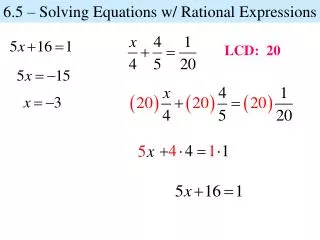
This guide covers the essentials of simplifying expressions and solving equations, focusing on combining like terms, using the addition and multiplication properties, and checking solutions. Examples illustrate the process of simplifying equations step-by-step, including determining if a number is a solution and solving for variables using both addition and multiplication. Each example is followed by a verification check to confirm the solution is correct, making this resource ideal for students looking to master these fundamental math concepts.

Simplifying Expressions and Solving Equations: Key Properties and Examples
E N D
Presentation Transcript
Combine Like terms • Simplify • 3x+2x= • 3x+2y+2x+7y= • 3x+5x-2= • 14x+y-2x+4y-7=
Parallel Example 1 Determining Whether a Number is a Solution of an Equation Is 9 a solution of either one of these equations? a. 16 = x + 7 b. 3y + 2 = 30 Replace x with 9. Replace y with 9. 3y + 2 = 30 16 = x + 7 3(9) + 2 = 30 16 = 9 + 7 27 + 2 = 30 16 = 16 True 29 = 30 False 9 is a solution of the equation. 9 is not a solution of the equation. Slide 9.6- 3
Parallel Example 2 Solving Equations Using the Addition Property Solve each equation. a. m – 13 = 28 m – 13 + 13 = 28 + 13 m + 0 = 41 Check: m = 41 m – 13 = 28 The solution is 41. To check, replace m with 41 in the original equation. 41 – 13 = 28 28 = 28 The result is true, so 41 is the solution. Slide 9.6- 5
Parallel Example 2 continued Solving Equations Using the Addition Property Solve each equation. b. 5 = n + 7 5 + (−7) = n + 7 + (–7) –2 = n + 0 Check: –2 = n 5 = n + 7 The solution is −2. To check, replace n with −2 in the original equation. 5 = −2 + 7 5 = 5 The result is true, so −2 is the solution. Slide 9.6- 6
Parallel Example 3 Solving Equations Using the Multiplication Property Solve each equation. a. 6k = 54 Divide both sides by 6, to get k by itself. 1 1 Check: The solution is 9. To check, replace k with 9 in the original equation. 6k = 54 6 ∙ 9 = 54 54 = 54 The result is true, so 9 is the solution. Slide 9.6- 8
Parallel Example 3 continued Solving Equations Using the Multiplication Property Solve each equation. b. −8y = 32 Divide both sides by −8, to get y by itself. 1 1 Check: −8y = 32 −8(−4) = 32 The solution is −4. To check, replace y with −4 in the original equation. 32 = 32 The result is true, so −4 is the solution. Slide 9.6- 9
Parallel Example 4 Solving Equations Using the Multiplication Property Solve each equation. a. Multiply both sides by 5, to get x by itself. 1 1 Check: The solution is 35. To check, replace x with 35 in the original equation. The result is true, so 35 is the solution. Slide 9.6- 10
Parallel Example 4 continued Solving Equations Using the Multiplication Property b. Multiply both sides by −9/2, to get m by itself. 2 1 1 Check: 1 1 1 −2 The solution is −18. To check, replace m with −18 in the original equation. 1 The result is true, so −18 is the solution. Slide 9.6- 11
Here is a summary of the rules for using the multiplication property. In these rules, x, is the variable and a, b, and c represent numbers. Slide 9.6- 12
Solving an Equation with Several Steps Solve 4w + 2 = 18. Step 1 Subtract 2 from both sides. Step 2 Divide both sides by 4. Step 3 Check the solution.
Solving an Equation with Several Steps Solve 4w + 2 = 18. The solution is 4 (not 18).
Examples • 14x=0
Hw Section 1.3 pg 44 • 1-28