Enhancing Coordination in International Disaster Assistance: Balancing Local Needs and External Support
This document explores the challenges and strategies for effective coordination of international disaster assistance. It examines the evolution of aid from the 1980s to the 1990s, emphasizing national sovereignty and the necessity for donor countries to work collaboratively with local authorities. The text highlights the roles of various stakeholders, including NGOs, health ministries, and disaster response teams, in planning and executing aid. It advocates for better communication, realistic assessments of needs, and strengthening national capacities to mitigate the risks of secondary disasters caused by unsynchronized external assistance.

Enhancing Coordination in International Disaster Assistance: Balancing Local Needs and External Support
E N D
Presentation Transcript
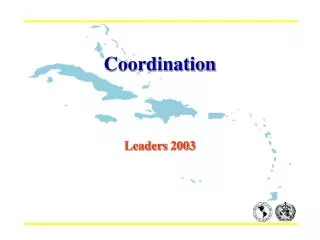
Coordination Leaders 2003
BILATERAL MULTILATERAL NGOs INTERNATIONAL ASSISTANCEIN PERSPECTIVE . . . ASSISTANCE FROM WITHIN THE COUNTRY EXTERNAL ASSISTANCE (1-2%)
FROM ONE EXTREME TO THE OTHER 1980’s National sovereignityof the affected country is absolute 1990’s Donor countryknows best!
ASSISTANCE REQUESTS FOREIGN AFFAIRS PRESIDENCY INTERNATIONAL COMMUNITY DISASTER AFFECTED COUNTRY MINISTRY OF HEALTH CIVIL DEFENSE RED CROSS/NGOs INDIVIDUAL HOSPITALS
THERE ARE DELAYS BETWEEN THE REQUEST AND THE ARRIVAL OF SUPPLIES SUBMISSION TO LOCAL REPRESENTATIVES PREPARATION OF REQUESTS REVISION BY DONOR AGENCIES ASSESSMENT OF NEEDS CONSULTATIONS BETWEEN ORGANIZATIONS DISASTER IMPACT DECISION AND PLEDGE OFFORMAL ASSISTANCE TRANSPORTATION PROCUREMENT OF GOODS RECEPTION ANDDISTRIBUTION
DURING NORMAL TIMES . . . I NEED ONE DOCTOR!
THE RIGHT THING I NEED ONE DOCTOR! DISASTER AREA
PAHO/WHO Cooperation in Disasters • coordinates international health assistance • Caribbean Response Team • Provides technical cooperation in the health field
Cooperation in disasters Coordinating International Health Assistance • participates in the assessment of external health needs • contributes to OCHA Situation Reports for health matters, medical care, water, nutrition, environmental health, . . . • assumes responsibility for health aspects of UNDAC operations when mobilized • informs donors of appropriateness of requests/offers PAHO/WHO
Cooperation in disasters National disaster coordinators are assisted in field assessments by: • specially trained staff in PAHO country offices and regional centers • experts from the regional disaster programs • consultants from the Region
Assessment of damages and needs • Over 100 PAHO experts on-site in Central America + 59 mobilized for this purpose • “Seasoned” disaster experts dispatched • All with a knowledge of local conditions prior to the hurricane
Coordinating External Assistance • Generate and disseminate information • Provide a forum for dialogue • NGOs and Governments • Donors and recipients
Some chaos is an integral part of all disasters Let’s ensure that external humanitarian assistance do not contribute to the‘secondary disaster’
When humanitarian assistance becomes a problem? • Unsolicited donations exceed the absorption capacity • Foreign teams bypass the national coordinator and take over • National priorities are overlooked • National institutions are weakened
External resources and influence may seem overwhelming: • Bilateral agencies • Mighty Military • International NGOs
Suggestions • A good and realistic assessment of needs: • Know and tell what you want and DO NOT want • Master communications with the media • Go to the donor public directly: Use the Internet
Suggestions • Monitor the trend towards humanitarian interventionism • Formulate a position at the ECOSOC, OAS, OCS and other political forum: • Clarify the responsibilities for coordination • Promote UNDAC as a tool at the service of national institutions • Support the SUMA approach of strengthening the national capacity rather than substituting it.