Download
1 / 30
310 likes | 443 Vues
Chapter 3 delves into the anatomy of a typical cell, emphasizing the characteristics that distinguish various cell types such as nerve, muscle, and blood cells. It covers crucial cell components including the plasma membrane, cytoplasm, and nucleus, explaining their individual functions. The text details the fluid mosaic model of membranes, the role of organelles like the endoplasmic reticulum and mitochondria, and the significance of the cytoskeleton. Understanding these elements is essential for grasping how cells operate and maintain life.

E N D
Anatomy of a cell Chapter 3
Typical Cell • Cells vary due to function. The typical cell exhibits the most important characteristics of many distinctive cell types. • Examples of cell types: Nerve cells, muscle cells, red blood cells, gland cells, and immune cells
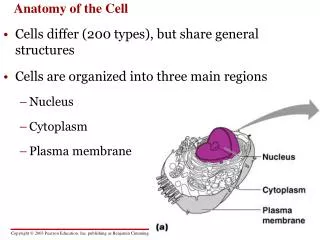
Functional Anatomy of Cells • Cell structures • Plasma membrane—separates the cell from its surrounding environment • Cytoplasm—thick gel-like substance inside of the cell composed of numerous organelles suspended in watery cytosol; each type of organelle is suited to perform particular functions • Nucleus—large membranous structure near the center of the cell
Cell Membranes • Each cell contains a variety of membranes: • Plasma membrane • Membranous organelles—sacs and canals made of the same material as the plasma membrane
Cell Membranes • Fluid mosaic model—theory explaining how cell membranes are constructed • Molecules of the cell membrane are arranged in a sheet • The mosaic of molecules is fluid; that is, the molecules are able to float around slowly • This model illustrates that the molecules of the cell membrane form a continuous sheet
Cell Membranes • Primary structure of a cell membrane is a double layer of phospholipid molecules • Heads are hydrophilic (water-loving) • Tails are hydrophobic (water-fearing) • Molecules arrange themselves in bilayers in water • Cholesterol molecules are scattered among the phospholipids to allow the membrane to function properly at body temperature • Most of the bilayer is hydrophobic; therefore water or water-soluble molecules do not pass through easily
Plasma Membranes and Proteins • A cell controls what moves through any section of membrane by means of proteins embedded in the phospholipid bilayer. • The protein acts as a gate allowing water-soluble molecules to pass through the membrane.
Cytoplasm and Organelles • Cytoplasm—gel-like internal substance of cells that includes many organelles suspended in watery intracellular fluid called cytosol
Cytoplasm and Organelles • Two major groups of organelles: • Membranous organelles are specialized sacs or canals made of cell membranes • Nonmembranous organelles are made of microscopic filaments or other nonmembranous materials
Organelles • Endoplasmic reticulum (Highway system of the cell) • Made of canals with membranous walls and flat, curving sacs arranged in parallel rows throughout the cytoplasm; extend from the plasma membrane to the nucleus • Proteins move through the canals
ER • Two types of ER: 1) Rough ER: Ribosomes on the outer surface of the organelle 2) Smooth ER: Synthesizes certain lipids and carbohydrates and creates membranes for use throughout cell
nonmembranous structure • Ribosomes in the endoplasmic reticulum make proteins for “export” or to be embedded in the plasma membrane; free ribosomes make proteins for the cell’s domestic use
Golgi apparatus • Golgi apparatus (UPS of cell): flat-like pancake organelle that packages and delivers proteins and other organic molecules throughout the cell.
Lysosomes • Lysosomes (miniature stomach)- enzymes in lysosomes digest the protein structures of defective cell parts, including plasma membrane proteins, and particles that have become trapped in the cell
Mitochondria • Mitochondria (power plant of cell)- mitochondrial enzymes catalyze series of oxidation reactions that provide about 95% of cell’s energy supply • Each mitochondrion has a DNA molecule, allowing it to produce its own enzymes and replicate copies of itself
Nucleus • Consists of nuclear envelope (composed of two membranes each with essentially the same molecular structure as plasma membrane) surrounding nucleoplasm; nuclear envelope has holes called nuclear pores
Cytoskeleton • The cell’s internal supporting framework made up of rigid, rodlike pieces that provide support and allow movement and mechanisms that can move the cell or its parts (Figure 3-13)
Centrosome • An area of the cytoplasm near the nucleus that coordinates the building and breaking of microtubules in the cell- Important in cell division