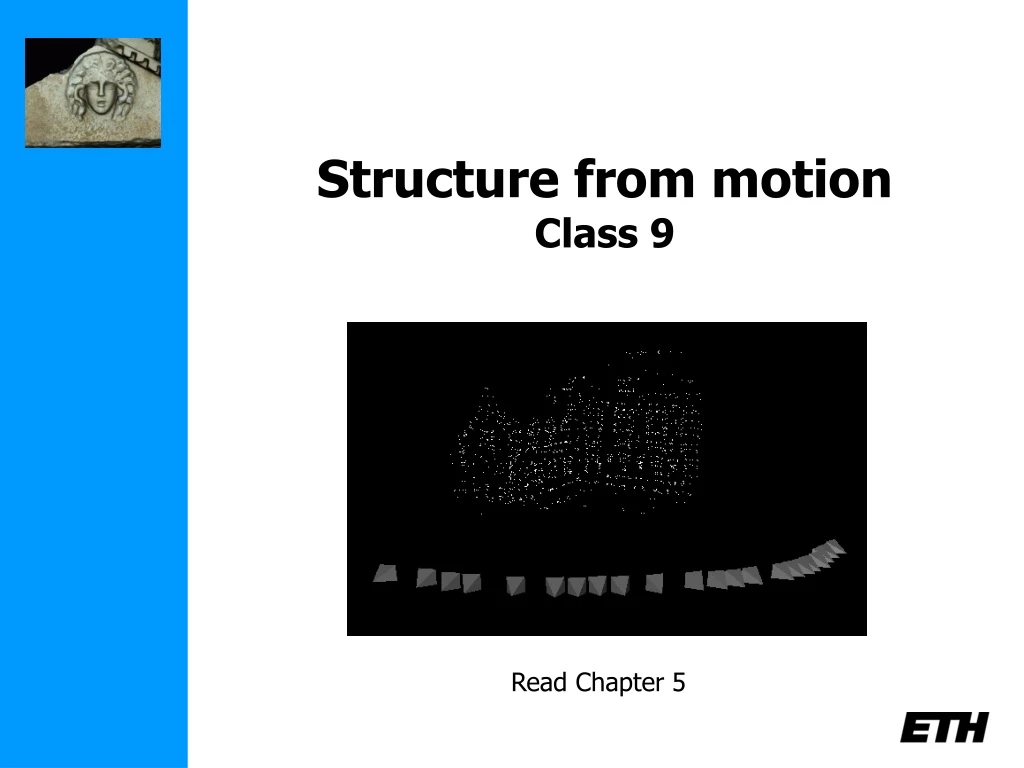

Structure from motion Class 9
E N D
Presentation Transcript
Structure from motionClass 9 Read Chapter 5
Today’s class • Structure from motion • factorization • sequential • bundle adjustment
Factorization • Factorise observations in structure of the scene and motion/calibration of the camera • Use all points in all images at the same time • Affine factorisation • Projective factorisation
Affine camera The affine projection equations are how to find the origin? or for that matter a 3D reference point? affine projection preserves center of gravity
All equations can be collected for all i and j • where Orthographic factorization (Tomasi Kanade’92) The ortographic projection equations are where Note that P and M are resp. 2mx3 and 3xn matrices and therefore the rank of m is at most 3
Orthographic factorization (Tomasi Kanade’92) Factorize m through singular value decomposition An affine reconstruction is obtained as follows Closest rank-3 approximation yields MLE!
Orthographic factorization (Tomasi Kanade’92) Factorize m through singular value decomposition An affine reconstruction is obtained as follows • A metric reconstruction is obtained as follows • Where A is computed from 3 linear equations per view on symmetric matrix C (6DOF) A can be obtained from C through Cholesky factorisation and inversion
Examples Tomasi Kanade’92, Poelman & Kanade’94
Examples Tomasi Kanade’92, Poelman & Kanade’94
Examples Tomasi Kanade’92, Poelman & Kanade’94
Examples Tomasi Kanade’92, Poelman & Kanade’94
Perspective factorization The camera equations for a fixed image i can be written in matrix form as where
Perspective factorization All equations can be collected for all i as where In these formulas m are known, but Li,P and M are unknown Observe that PM is a product of a 3mx4 matrix and a 4xn matrix, i.e. it is a rank-4 matrix
Perspective factorization algorithm Assume that Li are known, then PM is known. Use the singular value decomposition PM=US VT In the noise-free case S=diag(s1,s2,s3,s4,0, … ,0) and a reconstruction can be obtained by setting: P=the first four columns of US. M=the first four rows of V.
Iterative perspective factorization When Li are unknown the following algorithm can be used: 1. Set lij=1 (affine approximation). 2. Factorize PMand obtain an estimate of P andM. If s5 is sufficiently small then STOP. 3. Use m, P and M to estimate Li from the cameraequations (linearly) miLi=PiM 4. Goto 2. In general the algorithm minimizes the proximity measure P(L,P,M)=s5 Note that structure and motion recovered up to an arbitrary projective transformation
Further Factorization work Factorization with uncertainty Factorization for dynamic scenes (Irani & Anandan, IJCV’02) (Costeira and Kanade ‘94) (Bregler et al. ‘00, Brand ‘01) (Yan and Pollefeys, ‘05/’06)
practical structure and motion recovery from images • Obtain reliable matches using matching or tracking and 2/3-view relations • Compute initial structure and motion • Refine structure and motion • Auto-calibrate • Refine metric structure and motion
Initialize Motion (P1,P2 compatibel with F) Sequential Structure and Motion Computation Initialize Structure (minimize reprojection error) Extend motion (compute pose through matches seen in 2 or more previous views) Extend structure (Initialize new structure, refine existing structure)
Computation of initial structure and motion according to Hartley and Zisserman “this area is still to some extend a black-art” • All features not visible in all images • No direct method (factorization not applicable) • Build partial reconstructions and assemble (more views is more stable, but less corresp.) 1) Sequential structure and motion recovery 2) Hierarchical structure and motion recovery
Sequential structure and motion recovery • Initialize structure and motion from two views • For each additional view • Determine pose • Refine and extend structure • Determine correspondences robustly by jointly estimating matches and epipolar geometry
Initial structure and motion Epipolar geometry Projective calibration compatible with F Yields correct projective camera setup (Faugeras´92,Hartley´92) Obtain structure through triangulation Use reprojection error for minimization Avoid measurements in projective space
Determine pose towards existing structure M 2D-3D 2D-3D mi+1 mi new view 2D-2D Compute Pi+1using robust approach (6-point RANSAC) Extend and refine reconstruction
Compute P with 6-point RANSAC • Generate hypothesis using 6 points • Count inliers • Projection error • 3D error • Back-projection error • Re-projection error • Projection error with covariance • Expensive testing? Abort early if not promising • Verify at random, abort if e.g. P(wrong)>0.95 (Chum and Matas, BMVC’02)
Dealing with dominant planar scenes (Pollefeys et al., ECCV‘02) • USaM fails when common features are all in a plane • Solution: part 1 Model selection to detect problem
Dealing with dominant planar scenes (Pollefeys et al., ECCV‘02) • USaM fails when common features are all in a plane • Solution: part 2 Delay ambiguous computations until after self-calibration (couple self-calibration over all 3D parts)
Non-sequential image collections Problem: Features are lost and reinitialized as new features 3792 points Solution: Match with other close views 4.8im/pt 64 images
Relating to more views • For every view i • Extract features • Compute two view geometry i-1/i and matches • Compute pose using robust algorithm • Refine existing structure • Initialize new structure For every view i Extract features Compute two view geometry i-1/i and matches Compute pose using robust algorithm For all close views k Compute two view geometry k/i and matches Infer new 2D-3D matches and add to list Refine pose using all 2D-3D matches Refine existing structure Initialize new structure Problem: find close views in projective frame
Determining close views • If viewpoints are close then most image changes can be modelled through a planar homography • Qualitative distance measure is obtained by looking at the residual error on the best possible planar homography Distance =
Non-sequential image collections (2) 2170 points 3792 points 9.8im/pt 64 images 4.8im/pt 64 images
Hierarchical structure and motion recovery • Compute 2-view • Compute 3-view • Stitch 3-view reconstructions • Merge and refine reconstruction F T H PM
Stitching 3-view reconstructions Different possibilities 1. Align (P2,P3) with (P’1,P’2) 2. Align X,X’ (and C’C’) 3. Minimize reproj. error 4. MLE (merge)
Refining structure and motion • Minimize reprojection error • Maximum Likelyhood Estimation (if error zero-mean Gaussian noise) • Huge problem but can be solved efficiently (Bundle adjustment)
Non-linear least-squares • Newton iteration • Levenberg-Marquardt • Sparse Levenberg-Marquardt
Newton iteration Jacobian Taylor approximation normal eq.
Levenberg-Marquardt Normal equations Augmented normal equations accept solve again l small ~ Newton (quadratic convergence) l large ~ descent (guaranteed decrease)
Levenberg-Marquardt Requirements for minimization • Function to compute f • Start value P0 • Optionally, function to compute J (but numerical ok, too)
Sparse Levenberg-Marquardt • complexity for solving • prohibitive for large problems (100 views 10,000 points ~30,000 unknowns) • Partition parameters • partition A • partition B (only dependent on A and itself)
Sparse bundle adjustment residuals: normal equations: with note: tie points should be in partition A
Sparse bundle adjustment normal equations: modified normal equations: solve in two parts:
P1 P2 P3 M U1 U2 W U3 WT V 3xn (in general much larger) 12xm Sparse bundle adjustment Jacobian of has sparse block structure im.pts. view 1 Needed for non-linear minimization
U-WV-1WT WT V 3xn 11xm Sparse bundle adjustment • Eliminate dependence of camera/motion parameters on structure parameters Note in general 3n >> 11m Allows much more efficient computations e.g. 100 views,10000 points, solve 1000x1000, not 30000x30000 Often still band diagonal use sparse linear algebra algorithms
Sparse bundle adjustment normal equations: modified normal equations: solve in two parts:
Sparse bundle adjustment • Covariance estimation
Related problems • On-line structure from motion and SLaM (Simultaneous Localization and Mapping) • Kalman filter (linear) • Particle filters (non-linear)
Open challenges • Large scale structure from motion • Complete building • Complete city