Download
1 / 2
0 likes | 9 Vues
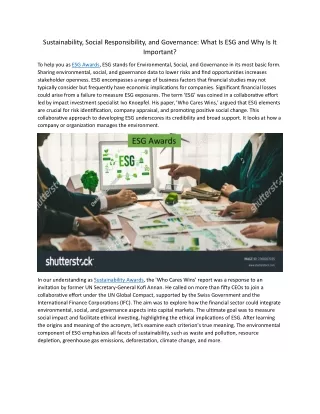
To help you as ESG Awards, ESG stands for Environmental, Social, and Governance in its most basic form. Sharing environmental, social, and governance data to lower risks and find opportunities increases stakeholder openness. ESG encompasses a range of business factors that financial studies may not typically consider but frequently have economic implications for companies. Significant financial losses could arise from a failure to measure ESG exposures. The term 'ESG' was coined in a collaborative effort led by impact investment specialist Ivo Knoepfel. His paper, 'Who Cares Wins,' argued that

E N D
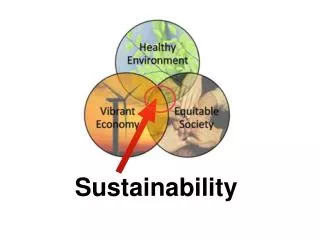
Sustainability, Social Responsibility, and Governance: What Is ESG and Why Is It Important? To help you as ESG Awards, ESG stands for Environmental, Social, and Governance in its most basic form. Sharing environmental, social, and governance data to lower risks and find opportunities increases stakeholder openness. ESG encompasses a range of business factors that financial studies may not typically consider but frequently have economic implications for companies. Significant financial losses could arise from a failure to measure ESG exposures. The term 'ESG' was coined in a collaborative effort led by impact investment specialist Ivo Knoepfel. His paper, 'Who Cares Wins,' argued that ESG elements are crucial for risk identification, company appraisal, and promoting positive social change. This collaborative approach to developing ESG underscores its credibility and broad support. It looks at how a company or organization manages the environment. In our understanding as Sustainability Awards, the 'Who Cares Wins' report was a response to an invitation by former UN Secretary-General Kofi Annan. He called on more than fifty CEOs to join a collaborative effort under the UN Global Compact, supported by the Swiss Government and the International Finance Corporations (IFC). The aim was to explore how the financial sector could integrate environmental, social, and governance aspects into capital markets. The ultimate goal was to measure social impact and facilitate ethical investing, highlighting the ethical implications of ESG. After learning the origins and meaning of the acronym, let's examine each criterion's true meaning. The environmental component of ESG emphasizes all facets of sustainability, such as waste and pollution, resource depletion, greenhouse gas emissions, deforestation, climate change, and more.
As an ESG Award, it looks at how a company or organization manages the environment. Companies now understand that their actions will only exacerbate the effects of climate change and jeopardize our planet and their continued viability as members of society. An increasing number of companies realize that the time has come to contribute to the solution rather than seeing environmental harm as an inevitable byproduct of their activities. The social criterion in ESG examines how an organization's activities affect its workers' and other community members' labor and human rights. This includes workplace conditions, diversity and inclusion initiatives, employee volunteerism, pay parity, and equity. Since an organization's environmental impact is more straightforward to quantify, the ecological part of ESG frequently takes Centre stage over the social or governance aspects. We believe as a Sustainability Award, minimizing risk and guaranteeing that the company operates ethically depends heavily on how an organization treats its workers and employees. The governance component of ESG looks at how a business is run and how it polices itself. The governance aspect usually causes the most complexity, but the environmental and social parts are simple. Responsible governance involves an organization's attempts to maintain accountability, transparency, and compliance. This entails being accountable to shareholders, seeking diversity in leadership selection while avoiding conflicts of interest, employing accurate and open accounting procedures, abstaining from unlawful behavior, and more. In the past, social and environmental initiatives were viewed more as an afterthought to regular company operations. Being an ESG Awards, the organization's governance activities heavily rely on its relationships with stakeholders to build trust through accountability and transparency. Environmental, social, and governance simply refer to material risk concerns that are valuable independently of the overarching criterion, even if the name promotes segmenting reporting into these three categories. For example, whether or not they are classified as "environmental" or "social," carbon outputs and equitable compensation are significant risk factors. However, ESG reporting has grown in significance to the business model to lower risk and raise corporate accountability as stakeholders such as consumers, investors, employees, and others hold businesses responsible for their effects on human rights and the environment; corporate sustainability reporting is now considered standard practice for companies.