Download
1 / 16
160 likes | 270 Vues
This lesson explores the properties of parallelograms, a special type of quadrilateral with both pairs of opposite sides parallel. We will examine key theorems: opposite sides are congruent, opposite angles are congruent, consecutive angles are supplementary, and diagonals bisect each other. Multiple examples will be provided to illustrate these properties in action. Engage in the classwork/homework assignment on page 313, questions 1 through 33, to solidify your understanding of these geometric concepts.

E N D
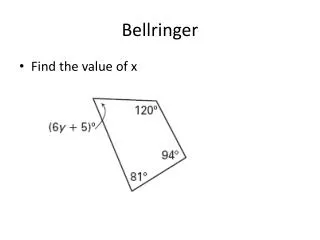
Bellringer • Find the value of x
Objectives • Use properties of parallelograms
Parallelogram • A parallelogram is a quadrilateral with both pairs of opposite sides parallel.
Theorem 6.2 • If a quadrilateral is a parallelogram then its opposite sides are congruent.
Theorems 6.3 and 6.4 • If a quadrilateral is a parallelogram, then its opposite angles are congruent • If a quadrilateral is a parallelogram, then its consecutive angles are supplementary.
Theorem 6.5 • If a quadrilateral is a parallelogram, then its diagonals bisect each other.
Classwork/Homework • Pg 313 #s 1-33