Compton Electrons
This document outlines the critical aspects of Compton recoil electron kinematics, emphasizing the energy loss and momentum analysis of struck electrons in high-energy physics experiments. Research highlights include the design requirements for electron detectors, such as spatial resolution, efficiency, and radiation hardness, along with a comparison of various detection technologies like Silicon, Scintillating Fiber, and GEM. Furthermore, we discuss signal rates, background influences, and budgeting considerations for future research initiatives, aiming to optimize detector performance and reliability in Compton scattering studies.

Compton Electrons
E N D
Presentation Transcript
Compton Electrons Dipangkar Dutta & Jeff Martin Mississippi State & University of Winnipeg
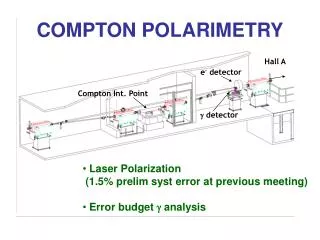
Compton Recoil Electron Kinematics • Struck electron loses energy equivalent to photon energy increase. Very little angular deflection. • At 850 MeV, max energy loss is E = 25 MeV [Bates]. • Struck electron is momentum analyzed using downstream dipole magnet. e.g. Mainz Compton
Compton Survey(focusing on electron detection) others: NIKHEF, VEPP-3, VEPP-4, SPEAR, CESR, DORIS, PETRA, HERA trans., LEP
Typical Requirements forElectron Detector (Mainz & Hall A) • ~ 0.5 mm spatial resolution in dispersive direction • high efficiency (no gaps) • high rate capability (up to 100 kHz) • rad hard Notes: • Both Mainz & Hall A use CW laser operation (we don’t intend to) • background rates highly dependent on energy and beam tune [Nanda, Hall A]
Rates Hall-A: Signal rate : 5KHz for 8mA current @ 500W (energy independent) Background : @ 2GeV is 2KHz (depends on beam tune) Hall-C: Laser power is ave. 90W with duty factor of 0.15% Signal rate: 15-20KHz at 180mA Background: low (scaled from Hall A rates) - Thanks S. Nanda Multiplicity: ~1.5 per pulse - Thanks Dave
Technologies Under Consideration for Hall C Compton • Silicon • advantages: proven technology (Hall A), acceptance easy to understand, rad hard. • disadvantages: slow? potentially high electronics costs. • SciFi • advantages: fast, cheap, use Si-PM readout • disadvantages: rad hardness? more difficult acceptance? • alternate: quartz fiber; same readout, very rad hard. • GEM • advantages: cheap, rad hard, fairly fast. • disadvantages: electronics costs hard to estimate, potentially complicated R&D project on its own.
Si cost estimate (C. Davis, et al 2005 NSERC submission) Note: RTI category 1 limit is $150 kCAD.
Options for Fiber Based Recoil Electron Detector • Scintillating Fiber Based Device (SciFi, e.g. Mainz Compton) • Quartz Fiber Based Device (e.g. SLAC Compton -photon detector, 25m resolution)
SciFi Based Electron Detector SciFi available from 3 manufacturers Bicron, Kuraray & Pol.Hi.Tech. Typical light yield 4.5 p.e./mm, for 1mm diameter fiber. Achieved resolutions of ~125mm. Kararay is the most radiation hard no damage detected when exposed to 1Mrad (tested with e- beams). E. C. Aschenauer et al. hep-ex/9710001 “We have not found any noticeable change in the detector properties over time.” -Yoshio Imai (Mainz Compton)
Quartz Fiber Based Detector Signal through Cerenkov radiation, thus low photon yield (only few% of photons is trapped) ~1 pe/GeV/cm. Also incidence angle dependent. But 25mm resolution achieved at SLAC, extremely radiation hard ~ 2 Grad, insensitive to soft synchrotron radiation and high linearity.
Light Detection Mainz used Multi Anode PMTs made by Hamamatsu SiPM: the new kid on the block Silicon Photo Multipliers - densely packed array of Avalanche Photo Diodes (~1000 in a 1mmx1mm grid) operating in Geiger mode (i.e. individual photo-electrons from each micro pixel cannot be distinguished). ~ 1 mm 20~100 mm 400 pixels ~ 8 mm Depletion region ~ 2 mm First developed and produced by CPTA Russia. Now also Hamamatsu Photonics Substrate
Roadmap to First Light • Decide technology ASAP • Base decision on: • rates (signal and background) • granularity (guess similar to Hall A and Mainz?) • fiducializability? • Current favorite: …? Input from collaboration/experts? • Begin detailed budgeting for upcoming grant cycles • NSERC: deadline end of Oct. • DOE: deadline Nov. • Need ideas on how to split tasks (MSU vs. UWpg/Canadians) • Detailed simulations – decide position wrt chicane dipoles. • Prototyping • Receive funding • Build it