Testing General Relativity with Gravitational Lensing
This presentation by Rhondale Tso and Dr. Quentin Bailey from Embry-Riddle Aeronautical University delves into the fundamentals of General Relativity, discussing the key concept that curvature arises from energy and momentum. It explores how matter alters spacetime properties, affecting the paths of light and gravity. The talk addresses potential incompatibilities with Quantum Mechanics and the implications of Local Lorentz symmetry. It highlights ongoing experiments testing Lorentz symmetry and the applicability of the Standard Model Extension in predicting light bending around massive objects, along with future research directions.
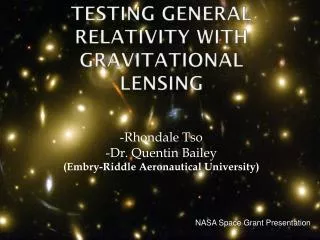

Testing General Relativity with Gravitational Lensing
E N D
Presentation Transcript
Testing General Relativity with Gravitational Lensing -Rhondale Tso -Dr. Quentin Bailey (Embry-Riddle Aeronautical University) NASA Space Grant Presentation
Basics of General Relativity Einstein Tensor Energy-Momentum Tensor *Curvature is caused by the Energy and Momentum. *Matter changes the properties of spacetime.
Basics of General Relativity Light-ray *Gravity corresponds to changes in the properties of space and time. *Alters the straightest possible, or shortest, paths that objects naturally follow (including light!!).
Incompatible with Quantum Mechanics (so far). • Assumes local Lorentz symmetry (locally the laws of physics obey special relativity). • Recent literature points to the possibility that Local Lorentz symmetry might be slightly broken. • Standard Model Extension (SME) framework describes this scenario general using modern"field theory" What’s wrong with General Relativity?
SME experiments testing Lorentz symmetry to date: • meson oscillations (BABAR, BELLE, DELPHI, FOCUS, KTeV, OPAL, …) • neutrino oscillations (MiniBooNE, LSND, Minos, Super K,… ) • muon tests (Hughes, BNL g-2) Yale, … • spin-polarized torsion pendulum tests (Adelberger, Hou, …) U. of Washington • tests with resonant cavities (Lipa, Mueller, Peters, Schiller, Wolf, …) • Stanford, Institut fur Physik, Univ. West. Aust. • clock-comparison tests (Hunter, Walsworth, Wolf, …) Harvard-Smithsonian • Penning-trap tests (Dehmelt, Gabrielse, …) U. of Washington • Lunar laser ranging (Battat, Stubbs, Chandler) Harvard • Atom interferometric gravimeters (Chu, Mueller, …) Stanford • cosmological birefringence (Carroll, Jackiw, Mewes, Kostelecky) MIT, IU • pulsar timing (Altschul) South Carolina • synchrotron radiation (Altschul) South Carolina • Cosmic Microwave Background (Mewes, Kostelecky) Marquette U., IU
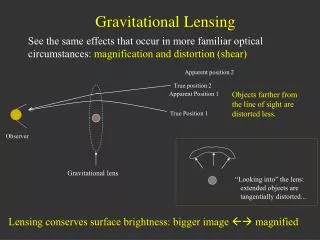
Due to curvature of spacetime light gets bent around massive objects; General Relativity prediction: Standard Model Extension prediction: Introduce “s-bar” coefficients. *SME prediction can be applied to the Lensing Equation. *S-bar coefficients tell whether Lorentz Violations affects gravity, if the S-bar=0, then no Lorentz Violations.
Results and Upcoming tests. • Application to Light Bending is still underway. Future tests to detect deviations include: • Global Astrometric Interferometer for Astrophysics (GAIA), from the ESA. • Very Long Baseline Interferometer (VLBI).