CAD Tool
The Biochemical Automated Modular Biochemical Instantiator (BAMBI) framework provides a powerful tool for analyzing and characterizing the stochastic behavior of natural biological systems, specifically the Lambda Bacteriophage model. With the capability to simulate 19 reactions across 17 types, BAMBI facilitates the exploration of natural stochasticity in cellular responses, such as lysis and lysogeny, along with measures of accuracy and robustness. Applications include biochemical sensing, drug production, and disease treatment, drawing insights from Monte Carlo simulations to enhance synthetic model performance.

CAD Tool
E N D
Presentation Transcript
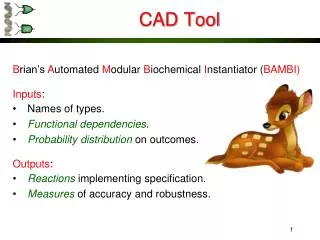
CAD Tool Brian’s Automated Modular Biochemical Instantiator (BAMBI) • Names of types. • Functional dependencies. • Probability distribution on outcomes. Inputs: Outputs: • Reactions implementing specification. • Measures of accuracy and robustness.
Natural Stochasticity “Choice” Dead Cell Lambda Bacteriophage (Adam Arkin, 1998) Hijack (Lysis) Stealth (Lysogeny)
Natural Stochasticity “Choice” Dead Cell “Portfolio” of Responses Prob. 0.2 Prob. 0.8
Modeling Natural Systems Lambda Bacteriophage(Adam Arkin, 1998) • Real model: 117 reactions in 61 types. • Our synthetic model: 19 reactions in 17 types. Curve-fits for data from Monte Carlo simulations for both the natural and synthetic models, sweeping the quantity of the input type moi from 1 through 10.
Synthesizing Stochasticity • (potential) Applications:biochemical sensing, drug production, disease treatment. • (immediate) Impetus: framework for analyzing and characterizing the stochastic behavior of natural biological systems. Synthesizing Stochasticity in Biochemical Systems
Reduced-Order Modeling Lambda Bacteriophage(Adam Arkin, 1998) • Real model: 117 reactions in 61 types. • Our synthetic model: 19 reactions in 17 types. Curve-fits for data from Monte Carlo simulations for both the natural and synthetic models, sweeping the quantity of the input type moi from 1 through 10.
Natural Stochasticity “Choice” Dead Cell Lambda Bacteriophage (Arkin et al., 1998) “Portfolio” of Responses Lysis Lysogeny Prob. 0.2 Prob. 0.8
Natural Stochasticity cI2 moi BiochemicalReactions Lambda Bacteriophage (Arkin et al., 1998) lysis lysogeny
Synthesizing Stochasticity Lambda Bacteriophage (Arkin et al., 1998) • Real model: 117 reactions in 61 types. • Our synthetic model: 19 reactions in 17 types. Synthesizing withBAMBI
Synthesis Results Curve-fits for data from Monte Carlo simulations for both the natural and synthetic models, sweeping the quantity of the input type moifrom 1 through 10.