Mastering Complex Numbers: Addition, Subtraction, and Multiplication Explained
Dive into complex numbers with this comprehensive guide covering addition, subtraction, and multiplication. Learn how to effectively add real and imaginary parts, subtract complex numbers step-by-step, and use the distributive property for multiplication. Explore examples that clarify each operation, including the important concept of complex conjugates and their properties. This resource not only simplifies calculations but also strengthens your understanding of complex number operations, making it an essential tool for math enthusiasts and students.

Mastering Complex Numbers: Addition, Subtraction, and Multiplication Explained
E N D
Presentation Transcript
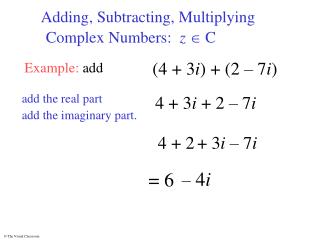
Adding, Subtracting, Multiplying Complex Numbers: z ÎC (4 + 3i) + (2 – 7i) Example: add add the real part 4 + 3i + 2 – 7i add the imaginary part. 4 + 2+ 3i – 7i – 4i = 6
Example: Subtract (5 + 2i) – (7 – 3i) remove brackets add the real part = 5 + 2i – 7 + 3i add the imaginary part. = 5 – 7+ 2i + 3i = – 2 + 5i
Multiplying Complex Numbers Example: Multiply the following (2 + 5i)(4 – 3i) (use distributive property) = 8 – 6i + 20i – 15i2 (i2 = –1) = 8 + 14i – 15(–1) = 8 + 14i + 15 = 23 + 14i
= –11 – 60i (5 – 6i)2 Simplify the following: (5 – 6i)(5 – 6i) = 25 – 30i – 30i + 36i2 = 25 – 60i + 36i2 (i2 = –1) = 25 – 60i + 36(–1) = 25 – 60i – 36
Conjugates 5 – 2i 5 + 2i 3 + 4i 3 – 4i –5 + 2i –5 – 2i a + bi a – bi
Simplify the following (conjugates): (5 – 6i)(5 + 6i) = 25 + 30i – 30i – 36i2 = 25 – 36i2 (i2 = –1) = 25 – 36(–1) = 25 + 36 = 61
Multiplying conjugates: Example: (a – bi)(a + bi) (2 – 7i)(2 + 7i) = a2 + abi – abi – b2i2 a b (i2 = –1) = a2 – b2i2 = 22 + 72 = 4 + 49 = a2 – b2(–1) = 53 = a2 + b2 Product of conjugates is always real.
Squaring Complex Numbers: Example: (3 + 5i)2 (a + bi)2 = (a + bi)(a + bi) a b = 32– 52 + 2(3)(5)i = a2 + abi + abi + b2i2 = 9 – 25 + 30i = a2 + b2i2 + 2abi = – 16 + 30i = a2 – b2 + 2abi (3 – 5i)2 (a + bi)2 = a2 – b2 + 2abi = – 16 – 30i (a – bi)2 = a2 – b2 – 2abi