The Abdomen
The Abdomen. Stuart M Bunt. Functional Anatomy 212. Overview. Embryology Revision. Foregut, Midgut and Hindgut suspended by the dorsal mesentary, initially straight Ventral mesentary connects stomach and ant. abd. wall, rest of gut free anteriorly

The Abdomen
E N D
Presentation Transcript
The Abdomen Stuart M Bunt Functional Anatomy 212
Embryology Revision • Foregut, Midgut and Hindgut suspended by the dorsal mesentary, initially straight • Ventral mesentary connects stomach and ant. abd. wall, rest of gut free anteriorly • Mesentary supplies blood and nerves to gut between layers of peritoneum • Complex adult layout due to 270o rotation
Blood Supply to Abdominal Organs • Foregut • Celiac trunk • Midgut • Superior mesenteric artery • Hindgut • Inferior mesenteric artery • Rectum • Internal iliac artery (pudendal and rectal arteries)
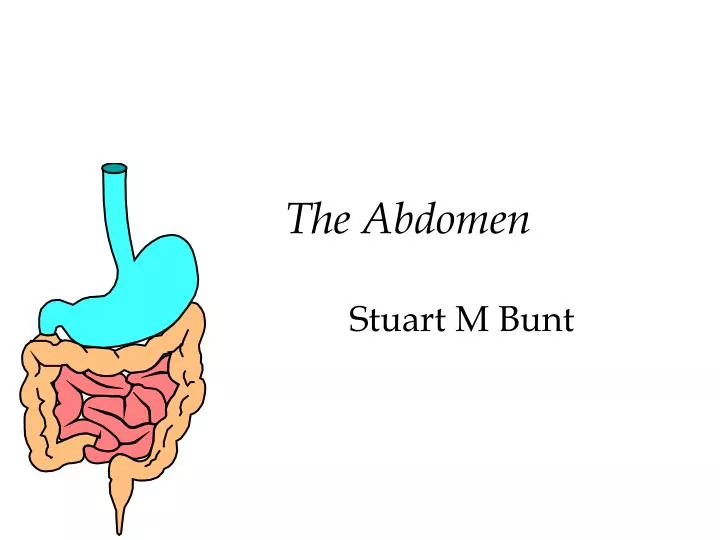
Stomach • Variable size and shape, distensible • J shaped related to body form • Lesser and greater curvature • gastroesophageal junction • fundus,cardiac part, body, pyloric part • pyloric antrum and sphincter • rugae and gastric pits
Venous system • Portal Vein • Splenic vein • inferior mesenteric vein • Superior mesenteric vein • Gastric veins • Hepatic Veins Inf. Vena Cava
Stomach rotates and distends Front Dorsal Mesentary Ventral Mesentary Back Splenic tissue Omentum Epiploic Foramen
The Peritoneal cavity is divided in two • Rotation of stomach forms the greater omentum (allows stomach distension and infection control) • Omental bursa or Lesser sac is inside omentum (a potential space) • Lesser omentum runs from stomach to liver (note free lower border above epiploic foramen contains portal vein, hepatic artery and bile duct • Falciform ligament runs from liver to ant abd. wall
Mesenteries are important:- • Paracolic gutters channel fuid • Stop herniation due to bipedal posture • Supply blood/nerves • Sensitive to stretch • Contain infection • Useful in surgery
On return some gut fuses with posterior wall Diaphragm 1 2 Duo. Asc. Colon Desc. Colon 3 1.lienorenal lig. 2.trans. mesocolon 3.mesentary proper 4.mes. of sig. colon 4 Rectum
Oesophagus • 10 inches from pharynx to stomach • narrow • at cricoid cartilage • where left bronchus crosses • oesophageal hiatus in diaphragm • mucous membrane folded (normally collapsed) • stratified squamous epithelium • striated above smooth below • trachea on right, • lower aorta on left • medial to L. lung, behind left atrium
Duodenum • first 12 inches of gut • four parts form C shape • duodenal cap • radiologically identified, ulcers form here • mobile • descending part • pancreatic and bile ducts • horizontal part • crosses psoas, IVC and aorta • crossed by mesentery, sup mesen. art. • ascending part
Jejunum • 2/5ths of small intestine • gradual transition to ileum • many small villi • increasing numbers of lymph nodules • no submucosal glands • lacteals in each villus • columnar epithelium
Ileum • distal 3/5ths of intestine • narrower, thinner, less vascular, slower, • more fat and arterial arcades in mesentery than jejunum. • Peyer’s patches of lymphoid tissue
Colon • ascending colon retroperitoneal • right colic or hepatic flexure • transverse colon (mesocolon) • droops towards pelvis? • left colic or splenic flexure • descending colon retroperitoneal • pelvic or sigmoid colon S shaped
The Liver • Largest Gland (one of largest organs) • Right upper abdomen under diaphragm • Grows as outgrowth of gut plus mesoderm • Diaphragmatic surface • Visceral surface down and left • related to stomach, duodenum, r. kidney, r. colonic flexure • bears gall bladder
Biliary System • R and L Hepatic ducts • Common hepatic duct • Joined by cystic duct (to gall bladder) • Forms bile duct (common bile duct) • Gall Bladder • body and fundus, salts and water absorbed • store for bile, released in response to cholecystokinin
Pancreas • Head in concavity of duodenum • body across vertebrae • tail reaches the spleen • pancreatic duct (+ accessory?) • ampulla • duodenal papilla
The Spleen • Lies in left hypochondriac region between gastric fundus and diaphragm at level of 9th-10th rib (not normally palpable) • Soft, friable, highly vascular, dark purple • Diaphragmatic surface • convex and smooth facing diaphragm • Visceral surface • gastric, renal, pancreatic and colic impressions
The Spleen (2) • Hilum of spleen long fissure through which vessels and nerves pass • Suspended from stomach by gastrolienal ligament (contains short gastric and left gastro-epiploic branches of spenic artery) • Suspended from posterior abdominal wall by lienorenal ligament • Covered by adherent peritoneum
Kidneys In fat capsule Suprarenal glands superiorly Direct Arterial and venous supply
Kidney Internal Structure • Renal pyramids between renal columns • Renal Cortex • Renal papillae drain into minor calix • Major calix join to form renal pelvis • Ureter as outlet
Kidneys External View • Artery - Vein - Ureter