Download
1 / 1
10 likes | 134 Vues
This document provides an analysis of the Nitrous Oxide (N2O) budget for the year 2000, focusing on both anthropogenic and natural sources. It lists total emissions in Tg N2O-N/yr, highlighting energy-related and non-energy-related contributions. The budget equations reveal the stratospheric loss rate and present-day net natural fluxes, while also discussing trends observed (+1 ppb/yr). Key sources include agriculture, waste, and natural ecosystems. The uncertainties associated with these emissions are also explored, emphasizing the significance of accurate data for climate change assessments.

E N D
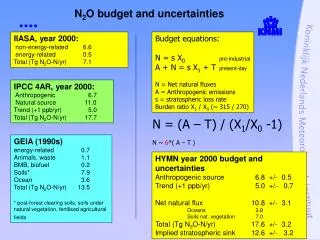
N2O budget and uncertainties IIASA, year 2000: non-energy-related 6.6 energy-related 0.5 Total (Tg N2O-N/yr) 7.1 Budget equations: N = s X0pre-industrial A + N = s X1 + T present-day N = Net natural fluxes A = Anthropogenic emissions s = stratospheric loss rate Burden ratio X1 / X0 (~ 315 / 270) IPCC 4AR, year 2000: Anthropogenic 6.7 Natural source 11.0 Trend (+1 ppb/yr) 5.0 Total (Tg N2O-N/yr) 17.7 N = (A – T) / (X1/X0 -1) N ~6*( A – T ) GEIA (1990s) energy-related 0.7 Animals, waste 1.1 BMB, biofuel 0.2 Soils* 7.9 Ocean 3.6 Total (Tg N2O-N/yr) 13.5 * post-forest clearing soils, soils under natural vegetation, fertilised agricultural fields HYMN year 2000 budget and uncertainties Anthropogenic source 6.8 +/- 0.5 Trend (+1 ppb/yr) 5.0 +/- 0.7 Net natural flux 10.8 +/- 3.1 Oceans 3.8 Soils nat. vegetation 7.0 Total (Tg N2O-N/yr) 17.6 +/- 3.2 Implied stratospheric sink 12.6 +/- 3.2