Download
1 / 20
200 likes | 358 Vues
This document explores the molecular orbitals of nitrogen (N2), oxygen (O2), and fluorine (F2), including the basis of their 1s and 2p orbitals. It discusses symmetry reducing the complexity of calculations and how combinations of orbitals can transform into each other. The bond orders for these diatomic molecules are derived through the number of bonding and antibonding electrons. Additionally, Hund's rules for electron distribution in degenerate orbitals are addressed, guiding the understanding of molecular stability and energy.

E N D
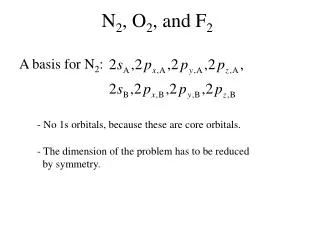
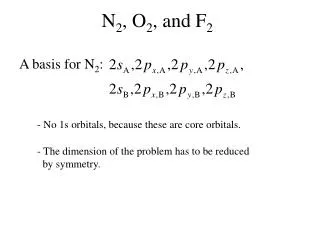
A basis for N2: N2, O2, and F2 - No 1s orbitals, because these are core orbitals. - The dimension of the problem has to be reduced by symmetry.
N2, O2, and F2 (continued) Intermezzo: The 2p orbitals.
N2, O2, and F2 (continued) Intermezzo: The 2p orbitals.
N2, O2, and F2 (continued) A B Symmetry elements:
N2, O2, and F2 (continued) A B Make plus and minus combination from orbitals that transform into each other.
N2, O2, and F2 (continued) combination group I II III IV V VI II I
N2, O2, and F2 (continued) group I: group II: group III: group IV: group V: group VI: - There is no interaction between orbitals of different groups. - The eight-dimensional problem is reduced to six smaller problems. - The one-dimensional problems directly give solutions of the Fock-equation. - Groups III and V, and groups IV and VI give degenerate solutions.
N2, O2, and F2 (continued) N N2 N
N2, O2, and F2 (continued) N N2 N
N2, O2, and F2 (continued) Bond-order = (# bonding electrons - # antibonding electrons)/2 = (8 - 2) / 2 = 3 N N2 N
N2, O2, and F2 (continued) MO of N2:
N2, O2, and F2 (continued) MO of N2:
N2, O2, and F2 (continued) MO of N2:
N2, O2, and F2 (continued) MO of N2:
N2, O2, and F2 (continued) MO of N2:
N2, O2, and F2 (continued) MO of N2:
N2, O2, and F2 (continued) O O2 O Bond-order = (# bonding electrons - # antibonding electrons)/2 = (8 - 4) / 2 = 2
N2, O2, and F2 (continued) Hund’s second rule: The Slater-determinant has the lowest energy if electrons are distributed as much as possible over degenerated orbitals. Hund’s third rule: The Slater-determinant has the lowest energy if electrons are placed in degenerated orbitals with the same spin.
N2, O2, and F2 (continued) F F2 F Bond-order = (# bonding electrons - # antibonding electrons)/2 = (8 - 6) / 2 = 1