The Respiratory System
The respiratory system is essential for life, facilitating the exchange of oxygen and carbon dioxide. This system includes vital organs such as the lungs, which are spongy structures resting on the diaphragm. The diaphragm plays a critical role in breathing by controlling airflow during inhalation and exhalation. Oxygen is absorbed into the bloodstream through capillaries, and carbon dioxide is expelled as a waste product. Understanding these processes is crucial for educating middle school students about human biology and health.

The Respiratory System
E N D
Presentation Transcript
The Respiratory System Adela Genoves G510 Life Science for Middle School Educators
What is the Respiratory System? • The organs and organ components that work together to enable us to breath.
What is Breathing? • Breathing is the exchange of oxygen and carbon dioxide to and from our body. Oxygen Carbon dioxide
Interesting Point about Breathing • With every breath, more than 15 ounces (500 ml) of air is taken into the lungs.
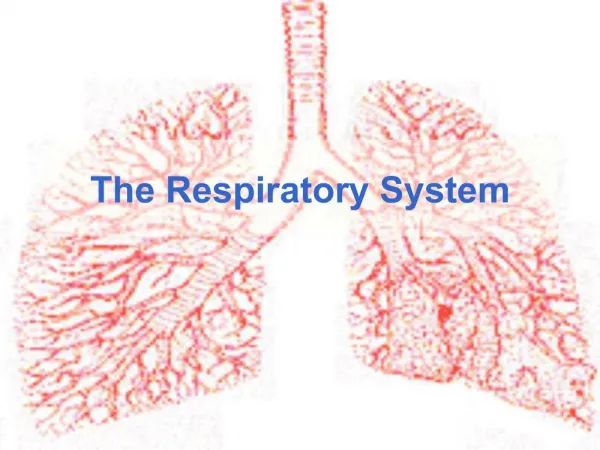
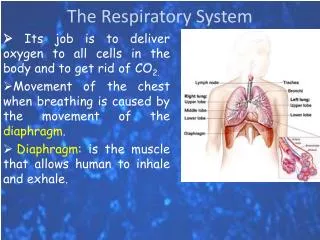
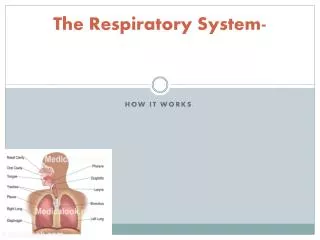
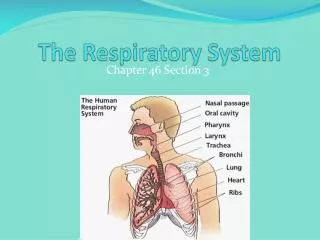
The Lungs • The Lungs are spongy organs • The Lungs rest on the diaphragm, a muscle that helps with bringing in and pushing out air • The Lungs provide the meeting site between Capillaries and Alveoli
Thorac0-Abdominal Diaphragm • The diaphragm acts as a partition between the cavity of the chest and that of the abdomen. • It is the chief muscle used in respiration, it is relaxed and dome-shaped during exhalation. • During inhalation it contracts, pulling downward, and with the combined contraction of the chest muscles allows the chest cavity to expand.
Gas Exchange- Breath-In OXYGEN • Oxygen is transferred to capillaries that carry red blood cells from the Lungs to Heart. From the Heart, the oxygen rich blood is circulated throughout the body. http://www.youtube.com/watch?v=1J8KFmoylEs
Gas Exchange- Breath Out Carbon dioxide • Carbon dioxide is a waste product made in our body • Blood cells deliver Carbon dioxide to the Lungs where it travels out from the body http://www.youtube.com/watch?v=vu_ONM3Bj9A
Capillaries • Capillaries are delicate vessels with fine walls that facilitate the exchange of gases between the blood and the tissues.
Red Blood Cells • The main function of red blood cells, or erythrocytes, is transporting oxygen to the cells. • Red blood cells contain a molecule called hemoglobin, to which oxygen binds until it reaches its destination.
Respiratory System in Action http://www.youtube.com/watch?v=ps64D3Juv5A
Questions? • Thank you!
References • http://images.google.com/imgres?imgurl=http://www.rkm.com.au/imagelibrary/thumbnails/oxygen-green-150.jpg&imgrefurl=http://www.rkm.com.au/imagelibrary/index.html&usg=__SWlXWSkWVBziDge5Fr-YG96I8_8=&h=150&w=150&sz=17&hl=en&start=89&um=1&tbnid=XU5CsSQ2pBGe2M:&tbnh=96&tbnw=96&prev=/images%3Fq%3Doxygen%2Bmolecule%26start%3D72%26ndsp%3D18%26um%3D1%26hl%3Den%26sa%3DN • http://upload.wikimedia.org/wikipedia/commons/thumb/9/9e/Lungs_diagram_simple.svg/483px-Lungs_diagram_simple.svg.png • http://www.daviddarling.info/encyclopedia/C/capillary.html • http://www.stemnet.nf.ca/~dpower/resp/exchange.htm#Internal • http://www.medicinenet.com/emphysema/article.htm • http://en.wikipedia.org/wiki/Diaphragm_(anatomy) • http://www.harunyahya.com/books/science/blood_heart/images/red_blood_cell_9.jpg • http://www.pennhealth.com/health_info/images/19443.jpg • http://images.google.com/imgres?imgurl=http://www.biology4kids.com/extras/dtop_micro/7315_580.jpg&imgrefurl=http://www.biology4kids.com/extras/dtop_micro/7315.html&usg=__9e27ODu4mLpchlfu144qIt3vOA0=&h=435&w=580&sz=25&hl=en&start=9&um=1&tbnid=BY42bsm6Si2xdM:&tbnh=101&tbnw=134&prev=/images%3Fq%3Dred%2Bblood%2Bcell%26hl%3Den%26sa%3DG%26um%3D1 • http://i271.photobucket.com/albums/jj160/cutiexxanne/Forest.jpg