Understanding Biomolecules: Key Terminology and Functions
Biomolecules are essential chemicals of life, encompassing carbohydrates, proteins, lipids, and nucleic acids. Key terms like monomers and polymers highlight the building blocks of these biomolecules. Monosaccharides, disaccharides, and polysaccharides illustrate carbohydrates, while proteins are formed from amino acids through dehydration synthesis. Additionally, lipids, including saturated and unsaturated fats, play vital roles in energy storage. Nucleic acids (DNA and RNA) are crucial for genetic information and protein synthesis. Metabolism encompasses catabolism and anabolism, facilitated by specific enzymes.

Understanding Biomolecules: Key Terminology and Functions
E N D
Presentation Transcript
BIOMOLECULES The chemicals of life
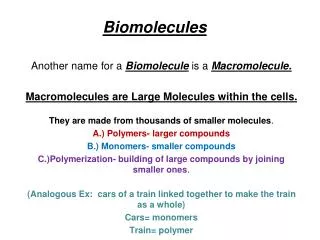
TERMINOLOGY • MONOMER • A single or simple piece • EX: glucose • POLYMER • Many pieces put together • EX: starch
DEHYDRATION SYNTHESIS • Putting monomers together to form polymers using chemical bonds. • Involves the loss of a water molecule. • Dehydration = loss of water • Synthesis = put together
HYDROLYSIS • Breaking apart polymers by adding a water molecule. • Hydro = water • Lysis = split
CARBOHYDRATES • Sugars and starches • “saccharides” • Three types: • Monosaccharides • Disaccharides • Polysaccharides
MONOSACCHARIDES • Mono = single • Saccharide = sugar • GLUCOSE • Base unit for starch, cellulose and glycogen • C6H12O6 • Blood sugar
MONOSACCHARIDES • GALACTOSE • Sugar found in milk • FRUCTOSE • Sugar found in honey
DISACCHARIDES • Double sugar • Two monosaccharides bonded together • C12H22O11 sucrose
DISACCHARIDES • SUCROSE • Glucose + Fructose • Table sugar • LACTOSE • Glucose + Galactose • Milk sugar • MALTOSE • Glucose + glucose • Sugar in beer
POLYSACCHARIDES • Poly = many • Many simple sugars chemically bonded together • STARCH • Long strands of glucose • Storage molecule for plants • EX: Potatoes
POLYSACCHARIDES • GLYCOGEN • Strands of glucose • Shorter than starch • Storage molecule for animals • CELLULOSE • Long strands of glucose • Found in wood, paper and cotton • Found in the cell walls of plants
PROTEINS • Long strands of amino acids • Approximately 20 different amino acids • Amino acids are joined by dehydration synthesis (water loss) to form peptide bonds • POLYPEPTIDE = chain of amino acids = protein • PROTEIN = many polypeptides
LIPIDS • Fats • Hydrophobic • Fats and oils are composed of two kinds of molecules • Glycerol • Fatty acids • 1 Glycerol + 3 Fatty Acids = Triglyceride
LIPIDS • SATURATED FATS • From animal sources • All single bonds in tail • Solid at room temperature • UNSATURATED FATS • Oils • From vegetable or plant sources • Carbon double-bonded in tail, kinked • Fewer H in tail • Liquid at room temperature
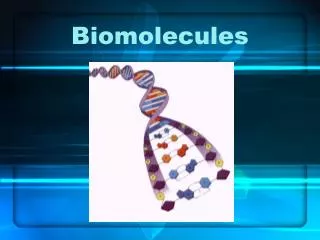
NUCLEIC ACIDS • DNA • Genetic material of organism • “Blueprint” • Found in cell nuclei • RNA • Functions in protein production DNA
NUCLEIC ACIDS • MONOMER = nucleotides • Nucleotide = phosphate + 5-carbon sugar + nitrogen base • DNA 5-carbon sugar = deoxyribose • RNA 5-carbon sugar = ribose
METABOLISM • The sum of all chemical reactions in an organism • CATABOLISM • Breaking down complex molecules into smaller ones. • ANABOLISM • Building more complex molecules from smaller.
ENZYMES • Usually end with –ase • Protein • Lock and key mechanism • Each enzyme fits with a specific substrate • Name usually corresponds with molecule that it breaks apart.
SPECIFIC ENZYMES • SALIVARY AMYLASE • In saliva • Breaks down starch chemically in the mouth • PROTEASE • Breaks down protein in the stomach • SUCRASE • Breaks down sucrose • LIPASE • Breaks down fat in the small intestine
EMULSIFICATION • Break down of larger fat molecules into smaller particles. • EX: Dish soap emulsifies fats