Understanding Human Genetics: Chromosomes, Inheritance, and Genetic Disorders
This chapter provides a comprehensive overview of human genetics, focusing on chromosomes and karyotypes, which consist of 23 pairs in humans. It explains the significance of pedigrees in tracking genetic traits, highlighting simple recessive and dominant heredity through examples such as albinism and Huntington’s disease. The text also explores codominance with sickle-cell anemia and multiple alleles in blood groups. Finally, it discusses sex-linked traits like colorblindness and hemophilia, as well as chromosomal changes like trisomy and syndromes, emphasizing applications in genetic testing and gene therapy.

Understanding Human Genetics: Chromosomes, Inheritance, and Genetic Disorders
E N D
Presentation Transcript
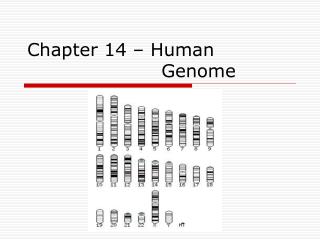
Human Chromosomes • Karyotype – arrangement of chromosomes in their homologous pairs and by length • Humans – 23 pair • 22 pair of autosomes • 1 pair of sex chromosomes
Pedigree • Graphic representation of genetic inheritance • Circle = female: square = male • Shaded = have trait; not shaded = do not have trait • Most recent generation at bottom • Generations identified by Roman numerals • Individuals identified by Arabic numbers (1,2,…)
Simple Recessive Heredity • Most genetic disorders are caused by recessive alleles • Albinism • Cystic fibrosis (CF) • 1 in 20 – carrier; 1 in 2000 – have it • Defective protein in plasma membrane results in formation and accumulation of thick mucus in lungs and digestive tract • Most common disorder among white Americans
Simple Recessive cont. • Tay-Sachs disease • Fatal disorder of central nervous system • Lipid build up on brain • Most common in US among Amish • Phenylketonuria (PKU) • Absence of enzyme that converts certain amino acids • Damage to CNS, mental retardation • Most common among people with ancestors from Norway and Sweden
Simple Dominant Heredity • Simple Dominant Traits • Tongue rolling, Hapsburg lip, earlobe types, hitchhiker’s thumb, almond eyes, thick lips, hair on middle of fingers • Huntington’s disease • Rare, lethal • Breakdown of brain • Onset between ages of 30-50 • Achondroplasia - dwarfism
Codominance in humans • Sickle-cell anemia • Twisted, bent (sickle-shaped) red blood cells • Cells are not able to carry oxygen normally, blood blow slows, blockage of smaller vessels, shorter life span for cells • Produces physical weakness and damage to heart and brain • Most common in African Americans • 1 out of 12 are heterozygous – produce normal and sickle
Multiple Alleles in humans • Blood groups – ABO groups and Rh group • Rh – single gene with 2 alleles – positive and negative • ABO groups • Determined by presence or absence of certain molecules on surface of red blood cell • Types : A, B, AB, O • Genes : IA, IB, i • Used to determine parentage • Ex. Child AB, mom A, man w/ O can not be father
Transfusions – need to know type to determine compatibility • A – IAIA, IAi • Can get from A or O • Can give to A or AB • B – IBIB, IBi • Can get from B or O • Can give to B or AB • AB – IAIB • Can get from A, B, AB, or O – universal recipient • Can give to AB • O – ii • Can get from O • Can give to A, B, AB, or O – universal donor
Sex-linked traits • Genes are found on the X or Y chromosomes • Colorblindness – most common red-green (found in 1/10 males in US) • Recessive on X chromosome • XBXB, XBXb – normal female • XbXb – colorblind female • XBY – normal male • XbY – colorblind male • Hemophilia – blood does not clot – may bleed to death from minor cuts • 1/10,000 males have • 1/1 million females have • Recessive on X chromosome
Calico cats • X chromosome may carry either black alleles or orange alleles • Females may have spots of both colors – 2 X chromosomes • Males only have one X chromosome so they will have black spots or orange spots but not both
Changes in chromosome # • Nondisjunction (homologous pairs do not split) occurs resulting in unusual numbers of autosomes – normal is 22 pair • Trisomy – have 3 of a certain autosome instead of 2 – results in 47 chromosomes • Ex. Down syndrome – trisomy of chromosome 21 – occurs 1/800 births
Changes in # cont. • Unusual numbers of sex chromosomes • Turner’s syndrome – females • Have only 1 X chromosome • Are sterile, sex organs may not develop • Klinefelter’s syndrome – males • Have an extra X – XXY • Usually sterile
Applications • Human DNA Analysis • Used to test for genetic disorders • DNA fingerprinting – used to identify individuals • Human Genome Project • Mapped the human DNA strand • Gene therapy – an absent or faulty gene is replaced by a normal, working gene • Still working on perfecting the practice