Enhancing DoD Logistics and Acquisition Integration for Efficient Vendor Invoicing and Acceptance
The Tri-Domain Working Group aims to streamline logistics functions within acquisition processes, focusing on integrating Receipt and Acceptance to support Accounting and Finance through the use of Wide Area Workflow (WAWF) as the Department of Defense (DoD) solution for invoicing and delivery. Current recommendations involve re-engineering receipt processes and enhancing WAWF capabilities to accommodate logistics systems. Key issues include managing multiple acceptances per shipment, correlating supply receipts with vendor shipments, and exploring acceptance scenarios across various locations, including remote and commercial environments.

Enhancing DoD Logistics and Acquisition Integration for Efficient Vendor Invoicing and Acceptance
E N D
Presentation Transcript
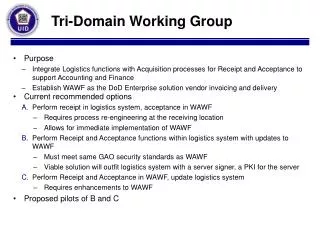
Tri-Domain Working Group • Purpose • Integrate Logistics functions with Acquisition processes for Receipt and Acceptance to support Accounting and Finance • Establish WAWF as the DoD Enterprise solution vendor invoicing and delivery • Current recommended options • Perform receipt in logistics system, acceptance in WAWF • Requires process re-engineering at the receiving location • Allows for immediate implementation of WAWF • Perform Receipt and Acceptance functions within logistics system with updates to WAWF • Must meet same GAO security standards as WAWF • Viable solution will outfit logistics system with a server signer, a PKI for the server • Perform Receipt and Acceptance in WAWF, update logistics system • Requires enhancements to WAWF • Proposed pilots of B and C
Tri-Domain Breakout • Issues/Questions: • Multiple acceptances per shipment • Correlation of supply receipts and vendor shipments • Ability to accumulate against vendor shipment number: where should this be done? • At WAWF • At each system • Scenarios • Shipboard and end-user acceptance • Ability to do acceptance at commercial shipyards, depots, deployed units; 3rd party acceptance • Remote and foreign locations and vendors • Supplies incident to services • Legacy government marking – how does government enter data into WAWF? UID Registry?
Legacy Items - Barriers • Funding • Systems engineering – drawing changes • Business case • Existing AIS systems don’t accommodate UID • Availability of AIT • Scope and quantity of legacy items • Change management to supply chain processes • Complexity of supply and maintenance chain
Legacy Items - Opportunities • Opportunistic, Gated, Inventory, Seek and Apply • Existing serial number tracking programs • CH-47, E-2C, H-53, F-16 • UITC • Munitions • Intermediary data stores • Allow capture and use of UID without modifying legacy systems • Depot maintenance • Vendor • Government • 3M system
Exemptions to UID Legacy Policy • General Issues • Determine when to physically UID item • How to get intelligence in the interim from existing systems • How to apply policy to existing long-term programs (determine application) • Standing equipment at DoD facilities • May need to split policy into parts • Parent-child business rules • Triggers: • Depot maintenance • Transfers ownership (property accountability to another organization) • Government Furnished Property (resident in plants) (virtual UID candidates) • Items coming out of stock before issuance
Exemptions to UID Legacy Policy • Strategies • Research/pull in NASA guidance • Consider alternative marking solutions • Expand enterprise solution (M. Reboulet) • Trailers as enterprise resources • Stand up new groups to focus on: • Foreign Military Sales • Disposal, demilitarized item marking requirements • Shipyard/shipboard • Item Manager Working Group