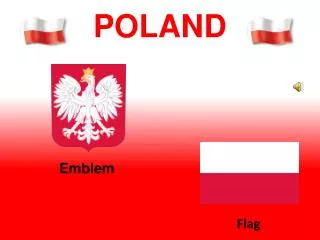
POLAND
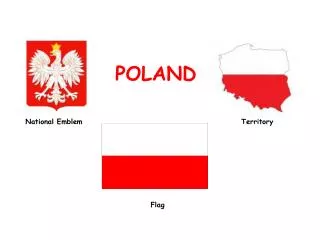
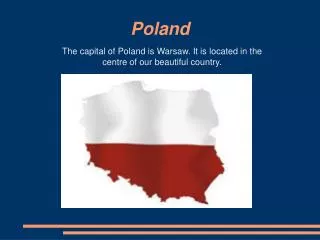
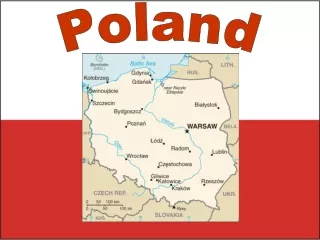
POLAND. Covered area 312000 sq km It occupies 3 per cent of Europe’s territory Good geographical situation, in Central Europe on the crossing of merchant routes With population of ca. 38 mln. people Population density 110 persons per sq km. Wrocław (polish language)

POLAND
E N D
Presentation Transcript
POLAND • Covered area 312000 sq km • It occupies 3 per cent of Europe’s territory • Good geographical situation, in Central Europe on the crossing of merchant routes • With population of ca. 38 mln. people • Population density 110 persons per sq km
Wrocław (polish language) Vratislavia / Budorgis (latin language) Brassel (dialect Silesia) Vratislav / Vroclav (czech language) Boroszlo (hungarian language)
Wroclaw • Capital City of Lower Silesia (south-west region of Poland), • With population of ca. 700 000 people • Major academic centre with universities and colleges • About 120 000 students every year
Labor force 17.26 million • agriculture: 16.1% • industry: 29.0% • services: 54.9%
Farming Agricultural
Percentage of land belonging on different type of farm (by size groups) Farm group (ha)
The biggest crops [t/ha]: Cereal: Vegetable: Wheat 3.8 Cabbage 40.5 Rye 2.4 Onion 20.5 Barley 3.0 Carrot 29.0 Oat 2.3 Triticale 3.3
Biggestcrops of fruit [thousands t]: • apple 2 830 • cherry 201 • plums 113 • black and redberry 196 • raspberry 81 • strawberry 20
Structure of age farmers: 18-29 years old 10% 30-39 years old 23% 40-54 years old 47% 55-65 years old 14% > 65 years old 6%
Advantages polish agriculture: • polish agriculturae area is 1/5 all agriculture area in UE • Poland has one of the richest varieties biological species and natural seats in UE • Poland is on the first place in wheat production • in Poland is extensive system of agriculture • very good quality of rural products • some of the farmers establish agrotouristic farms with traditional, ecology kind manage farm
Problems of rural area • Bad infrastructure, poor social and cultural development • Low farmer level education • Monoproduction in some regions and, high percentage of farmers with the income only from farming, • Difficulties with finding employment in non-agricultural sectors
Limited access to extension services • Low activity of farmers (rural residents) in social and cultural life • Hidden and registred unemployment • Low income resulting in limited demand for goods and non-agricultural services
Low impact of institiutions and organisations supporting the development of rural areas • Marginal attention focused to the cultural heritage
Problems of Polish Farming • Small-sized farms (< 8 ha) • Unsatisfactory organisation of the agri-cultural market and food chain links
Underinvestment of farms • Low farmers qualifications in production technologies, marketing and management • Poor self-organisation of farmers
Cattle stock (x1000) Cattle (others) Cows
Forage crop structure (thousand ha) Maize Grasses Legumes Roots