Certainty and Significant Figures
This guide explores the concepts of certainty and significant figures in measurements. It discusses how measurements can vary based on the measuring instrument used (e.g., two rulers) and the level of certainty associated with those measurements. Key rules for identifying significant figures are outlined, including considerations for non-zero digits, zeros, and estimating digits. Learn how many digits you can be confident in and the factors that limit certainty in measurement. This foundational understanding is crucial for accurate scientific reporting.

Certainty and Significant Figures
E N D
Presentation Transcript
Two measurements • How long is the object in the following picture? Which ruler did you use to obtain that measurement? Why?
Certainty • In your answer to the above example, how many digits do you feel certain are correct? Which ruler did you use? • If you used the other ruler, would you be more certain or less certain about your answer? • What factors limit your certainty between rulers?
Significant Figures are all about certainty • When a measurement is recorded, there are digits that you are certain about and digits that are estimated. • Every digit that you are certain about (based on the measuring device) is significant. • The first digit that is estimated (uncertain) is also significant. • No other digits are significant.
Example of certainty and significance . l2. . . . I . . . . I3 . . . .I . . . . I4. . cm First digit (certain) = 2 2.?? cm Second digit (certain) = 0.7 2.7? cm Third digit (estimated) between 0.05- 0.08 cm Length reported =2.77 cm or 2.76 cm or 2.78 cm
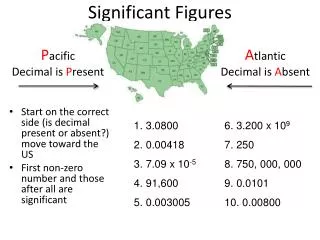
Rule 1 • Every nonzero digit is significant Examples: 24 2 3.56 3 7 1
Rule 2 • Zeros between non-zeros are significant Examples: 7003 4 40.9 3
Rule 3 • Zeros appearing in front of non-zero digits are not significant • Act as placeholders • Can’t be dropped, show magnitude Examples: 0.00024 2 0.453 3
Rule 4 • Zeros at the end of a number and to the right of a decimal point are significant. Examples: 43.00 4 1.010 4 1.50 3
Rule 5 • Zeros at the end of a number and to the left of a decimal point aren’t significant Examples: 300 1 27,300 3
The only rule for math functions • Round to the place that has the smallest number of significant figures in the calculation.