Transformation Through Technology: 1865-1900
Explore the impact of industrialization and technology revolution on daily life, transportation advancements, communication breakthroughs, and the rise of big business in the late 19th century America.


Transformation Through Technology: 1865-1900
E N D
Presentation Transcript
Industrialization Chapter 9
I. Technology Revolution • Daily Life in 1865: -no indoor electricity – used candles or oil lamps -no refrigeration – ice from frozen ponds stored in icehouses – expensive -slow communication
I. Technology Revolution • Daily Life in 1900: -1790-1860: only 36,000 patents issued (license to make, use, or sell an invention) -1860-1890: 500,000 patents issued -by 1900, the standard of living in the U.S. was the highest in the world
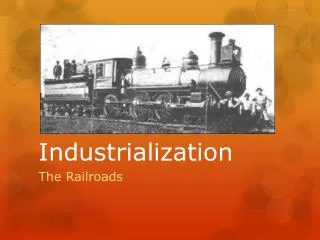
I. Technology Revolution • Railroads Improve Transportation: -before the Civil War: most tracks were short and didn’t connect major cities -there was also no standard width, or gauge, of tracks – very expensive to move goods
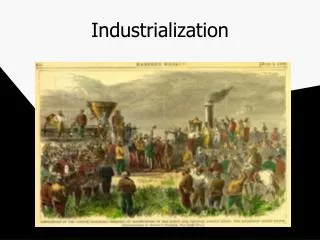
I. Technology Revolution -1st Transcontinental Railroad: completed in 1869 -coast to coast -Central Pacific built eastward -Union Pacific built westward -met at Promontory Point, UT -Impact: Opened up the West
I. Technology Revolution -problems: noisy, dirty, uncomfortable -improvements: steel rails replaced iron rails (more durable), standard gauges, improved safety (ex: better brakes) -another problem was scheduling: early 1800s each town set their own clock – national time zones were created in 1883 by the railroad industry
I. Technology Revolution • Advances in Communication: -telegraph – perfected by Samuel Morse – used the Morse Code to send electrical messages -Western Union Telegraph Company – formed after the C.W. – laid 100,000s of telegraph cable (1870: 100,000 miles 1900: 900,000 miles)
I. Technology Revolution -telephone – invented by Alexander Graham Bell in 1876 – teacher of the deaf in Boston – from Scotland
I. Technology Revolution • Electric Power: -Thomas Edison – made electricity more widely available -also invented the phonograph -set up shop in Menlo Park, NJ -greatest inventor of the day -developed light bulb in 1880
I. Technology Revolution -George Westinghouse – developed a new current that could be transmitted cheaper in 1885 -Electricity’s Impact: made refrigeration possible, created new jobs (ex: electric sewing machine allowed clothes to be mass produced) – rural areas did not benefit at first
I. Technology Revolution • The Bessemer Process: -1850s – Henry Bessemer made it easier and cheaper to mass produce steel – led to a new age of building – ex: skyscrapers, bridges, etc.
II. The Growth of Big Business: • It took a lot of money to build factories and develop these new inventions – business leaders often combined their funds to form large companies
II. The Growth of Big Business: • 2 views of the business leaders of this era: Were they… 1) “Robber Barons” – implies that business leaders built their fortunes by “stealing” from the public – eliminate competition = higher prices
II. The Growth of Big Business: 2) “Captains of Industry” – implies that business leaders served their country in a positive way by increasing the quality and quantity of goods and creating new jobs
II. The Growth of Big Business: • Andrew Carnegie: -born in Scotland – settled in Pittsburgh -made $50,000 a year in 1865 -created the Carnegie Steel Company in 1889 -created a monopoly, or complete dominance of an industry by one company, on the steel industry
II. The Growth of Big Business: -believed in the “gospel of wealth” – people should be free to make as much money as they can as long as they give some of it away -gave away $350 million by the time of his death in 1919
II. The Growth of Big Business: • Social Darwinism – the idea that strong businesses survive and the weak die – the rich used this to justify their wealth • Edwin L. (E.L.) Drake – developed and used the first oil well – Titusville, PA – nicknamed “Drake’s Folly” (people thought he was crazy)
II. The Growth of Big Business: • John D. Rockefeller: -formed the Standard Oil Company in 1863 -created a monopoly on the oil industry by underselling (cut throat) his competition -created a trust, or group of several companies managed by one board, in 1882 (40 companies)
II. The Growth of Big Business: -net worth in 1910: $310 billion in today’s money (2x’s as much as Bill Gates, Warren Buffett, and Sam Walton combined) *Sherman Anti-Trust Act: 1890 – outlawed any combination of companies that created a monopoly – not enforced
III. Industrialization and Workers • 1860-1900: 14 million immigrated to the U.S. for new opportunities (i.e. jobs) • Late 1800s: 8-9 million moved to the cities looking for jobs • Every family member worked because wages were low – children at ages 12 or 13 worked – no unemployment insurance
III. Industrialization and Workers • Factory workers often worked 12 hrs. a day, 6 or 7 days a week -they were paid by production not by the hour (piecework) – i.e. those that worked the fastest made the most money • Women were excluded from the high-paying jobs and had no chance to advance
Industrialization and Workers • 1882: average of 675 workers killed a week • No vacation, sick leave, unemployment • 20% of boys and 10% of girls under the age of 15 worked – including some as young as 5 • 1899 wages: women - $267 a year, men - $498 – Carnegie - $25 million
IV. The Great Strikes • Labor unions emerged during the late 1800s – wanted higher wages, fewer hours, and better working conditions • Knights of Labor – formed in 1869 – led by Terrence Powderly – united all skilled and non-skilled workers – little success
IV. The Great Strikes • American Federation of Labor – formed in 1886 – led by Samuel Gompers – organized only skilled workers • Industrial Workers of the World – nicknamed “Wobblies” – group in Chicago who opposed the AFL – focused on non-skilled workers
IV. The Great Strikes • Reaction of Employers: -hated unions – tried to stop their influence by: 1) firing union organizers 2) forbidding union meetings 3) forcing new workers to agree not to join a union 4) refusing to recognize unions
IV. The Great Strikes • Railroad Strike of 1877 – 1st major strike in the U.S. – railroad companies cut wages and violence erupted across the country – federal troops put down the strike • 1881-1900: 24,000 strikes in the U.S.
IV. The Great Strikes • Haymarket Riot – 1886 - workers wanted an 8 hr. work day - fight broke out between the strikers and scabs at the Chicago McCormick Reaper factory - bomb thrown by someone in Haymarket Square killed 7 police officers - riot followed with dozens killed on both sides
IV. The Great Strikes • Homestead Strike – 1892 – wages cut by Carnegie Steel – strike began in Homestead, PA – several killed • Pullman Strike – 1894 – the last of the great strikes -sleeping car maker George Pullman cut wages by 25% and laid off several workers
IV. The Great Strikes -120,000 railroad workers eventually joined the strike -federal gov’t ended the strike because the mail had to get through -increased federal involvement in labor strikes