
The Macroevolutionary Puzzle
E N D
Presentation Transcript
The Macroevolutionary Puzzle Chapter 18
Fossils and the Great Deluge • Fossils of seashells have been found in rock layers high in the mountains • How did they get there? • Initial explanation was that they had been deposited during the biblical flood
Evidence of Past Life • 1700s • Excavations unearthed similar fossil sequences in distant places • Scholars began to view these findings as evidence of the connection between Earth history and the history of life
What Do Fossils Tell Us? • As a result of mutations, natural selection, and drift, each species is a mosaic of ancestral and novel traits • All species that ever evolved are related to one another by way of descent
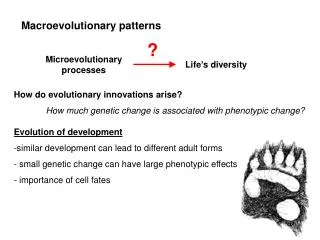
Macroevolution The large-scale patterns, trends, and rates of change among families and other more inclusive groups of species
Fossils • Recognizable evidence of ancient life • Fossilized hard parts (most common) • Trace fossils (indirect evidence)
Fossilization • Organism becomes buried in ash or sediments • Rapid burial and a lack of oxygen aid in preservation • The organic remains become infused with metal and mineral ions
Stratification • Fossils are found in sedimentary rock • This type of rock is formed in layers • In general, layers closest to the top were formed most recently
Radiometric Dating parent isotope in newly formed rock after one half-lives after two half-lives
Geologic Time Scale • Archean eon (oldest interval) • Proterozoic eon • Paleozoic era • Mesozoic era • Cenozoic era (most recent) • Boundaries based on abrupt transitions in fossil record • Correspond to mass extinctions
Record Is Incomplete • Fossils have been found for about 250,000 species • Most species weren’t preserved • Record is biased toward the most accessible regions
Continental Drift • Idea that the continents were once joined and have since “drifted” apart • Initially based on the shapes • Wegener refined the hypothesis and named the theoretical supercontinent Pangea
Changing Land Masses 420 mya 260 mya 65 mya 10 mya
Evidence of Movement • Wegener cited evidence from glacial deposits and fossils • Later was discovered that magnetic orientations in ancient rocks do not align with the magnetic poles • Discovery of seafloor spreading provided a possible mechanism
Plate Tectonics • Earth’s crust is fractured into plates • Movement of plates is driven by upwelling of molten rock at mid-oceanic ridges • As seafloor spreads, older rock is forced down into trenches
Forces of Change crustal margin of one plate being thrust under margin of another plate mid-oceanic range plumes of molten material
Comparative Morphology • Comparing body forms and structures of major lineages • Guiding principle: • When it comes to introducing change in morphology, evolution tends to follow the path of least resistance
Morphological Divergence • Change from the body form of a common ancestor • Produces homologous structures that may serve different functions
1 2 3 Morphological Divergence PTEROSAUR 4 1 2 CHICKEN 3 STEM REPTILE 2 PENGUIN 3 1 2 3 4 1 5 PORPOISE 2 4 5 3 1 2 BAT 3 4 5 1 2 3 4 HUMAN 5
Morphological Convergence • Individuals of different lineages evolve in similar ways under similar environmental pressures • Produces analogous structures that serve similar functions
Comparative Development • Each animal or plant proceeds through a series of changes in form • Similarities in these stages may be clues to evolutionary relationships • Mutations that disrupt a key stage of development are selected against
Altering Developmental Programs • Some mutations shift a step in a way that natural selection favors • Small changes at key steps may bring about major differences • Insertion of transposons or gene mutations
Development of Larkspurs • Two closely related species have different petal morphology • They attract different pollinators side view front view D. decorum flower side view front view D. nudicaule flower
Development of Larkspurs • Petal difference arises from a change in the rate of petal development 6 D. decorum 4 Petal length (millimeters) 2 D. nudicaule 0 0 10 20 40 Days (after onset of meiosis)
Similar Vertebrate Embryos • Alterations that disrupted early development have been selected against FISH REPTILE BIRD MAMMAL
Similar Vertebrate Embryos Aortic arches Adult shark Early human embryo Two-chambered heart Certain veins
Developmental Changes • Changes in the onset, rate, or time of completion of development steps can cause allometric changes • Adult forms that retain juvenile features
Proportional Changes in Skull Chimpanzee Human
Comparative Biochemistry • Kinds and numbers of biochemical traits that species share is a clue to how closely they are related • Can compare DNA, RNA, or proteins • More similarity means species are more closely related
Comparing Proteins • Compare amino acid sequence of proteins produced by the same gene • Human cytochrome c (a protein) • Identical amino acids in chimpanzee protein • Chicken protein differs by 18 amino acids • Yeast protein differs by 56
Sequence Conservation • Cytochrome c functions in electron transport • Deficits in this vital protein would be lethal • Long sequences are identical in wheat, yeast, and a primate
Sequence Conservation Yeast Wheat Primate
Nucleic Acid Comparison • Use single-stranded DNA or RNA • Hybrid molecules are created, then heated • The more heat required to break hybrid, the more closely related the species
Molecular Clock • Assumption : “Ticks” (neutral mutations) occur at a constant rate • Count the number of differences to estimate time of divergence
Taxonomy • Field of biology concerned with identifying, naming, and classifying species • Somewhat subjective • Information about species can be interpreted differently
Binomial System • Devised by Carl von Linne • Each species has a two-part Latin name • First part is generic • Second part is specific name
Higher Taxa • Kingdom • Phylum • Class • Order • Family • Inclusive groupings meant to reflect relationships among species
Phylogeny • The scientific study of evolutionary relationships among species • Practical applications • Allows predictions about the needs or weaknesses of one species on the basis of its known relationship to another
A Cladogram shark mammal crocodile bird feathers fur lungs heart
Five-Kingdom Scheme • Proposed in 1969 by Robert Whittaker Monera Protista Fungi Plantae Animalia
Three-Domain Classification • Favored by microbiologists EUBACTERIA ARCHAEBACTERIA EUKARYOTES
Six-Kingdom Scheme EUBACTERIA ARCHAEBACTERIA PROTISTA FUNGI PLANTAE ANIMALIA
Transitional Forms Archaeopteryx Dromaeosaurus