Exploring the Causes of World War I: Militarism, Alliances, Imperialism, and Nationalism
The causes of World War I can be summarized by the acronym M.A.I.N.: Militarism, Alliances, Imperialism, and Nationalism. Militarism involved a widespread glorification of military strength, leading to arms races, notably between Germany and Britain. Alliances created complex relationships that turned small conflicts into large-scale wars due to treaty obligations. Imperialism fueled competition for territories and resources, while nationalism stirred ethnic groups, especially in the Balkans, to seek independence, culminating in the assassination of Archduke Franz Ferdinand and the outbreak of the war.

Exploring the Causes of World War I: Militarism, Alliances, Imperialism, and Nationalism
E N D
Presentation Transcript
Causes of World War I can be remembered with the acronym M.A.I.N. M – Militarism A – Alliances I – Imperialism N - Nationalism
1. M - Militarism • Glorification of military strength was widespread in the 1800s • Led to “arms races” between countries of Europe • Most prominent was naval arms race between Germany and Britain
2. A - Alliances • Complicated system of alliances maintained peace in Europe • However, due to treaty obligations, a small scale conflict could pull in all the major powers
3. I - Imperialism • Empires were seen as a sign of national greatness • Competition for overseas territories & resources led to conflict
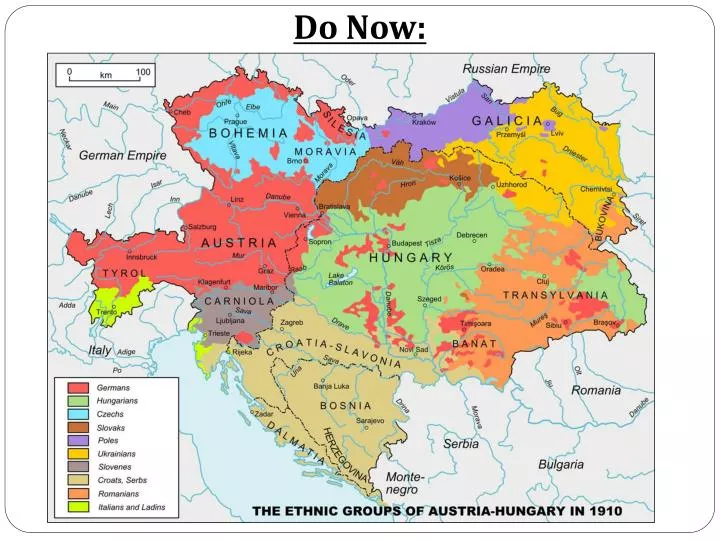
4. N – Nationalism • Different ethnic groups of Balkan region began demanding independence from Austria • Assassination of Archduke Franz Ferdinand caused Austria to declare war on Serbia • Soon, major powers were pulled into the conflict and WWI began
Militarism, Alliances, Imperialism, or Nationalism? Your Task: Below are a list of events leading to World War I; categorize them as an example of either M (militarism), A (alliances), I (imperialism), or N (nationalism).
__M__1.) Under Chancellor Otto von Bismarck, Germany began to strengthen its armed forces.
__A__ 2.) After Austria declared war on Serbia, treaty obligations caused Russia, Germany, France, and Britain to enter the conflict shortly thereafter.
__N__ 3.) A Serbian radical assassinated the heir to the Austrian throne in an attempt to get part of Austria with ethnic Serbs to merge with Serbia.
__I__ 4.) The European “Scramble for Africa” caused tensions between Britain, France, and Germany
__A__ 5.) Otto von Bismarck, seeking to weaken France, attempted to make a series of agreements to ensure friendly relations with Russia and Austria.
__N__ 6.) A variety of ethnic groups began to demand independence, threatening to break apart existing countries and empires, and led to the Balkans being referred to as "The Powder Keg of Europe."
__M/I__ 7.) In 1871, Germany and France fought the Franco-Prussian War so Germany could take the French territories of Alsace-Lorraine, where the majority of people spoke German. Caused long term bitterness between France and Germany.
__M__ 8.) Germany wanted to challenge British naval superiority by building up a strong navy of their own.