THE COMPARATIVE AND SUPERLATIVE FORM
110 likes | 224 Vues
This unit focuses on teaching students how to compare people, animals, and places using different types of adjectives. By the end of the unit, they will be able to construct sentences in the comparative and superlative form. Essential and content questions guide their learning process, while developing 21st-century skills such as communication and adaptability.


THE COMPARATIVE AND SUPERLATIVE FORM
E N D
Presentation Transcript
THE COMPARATIVE AND SUPERLATIVE FORM Writer Ayşe AY YİĞİT
THE TABLE OF CONTENTS 1.UNIT SUMMARY 2.AIMS 3.CURRICULUM-FRAMING QUESTIONS 4.TWENTY-FIRST CENTURY ABILITIES 5. BIBLIOGRAPHY 6.THANKS
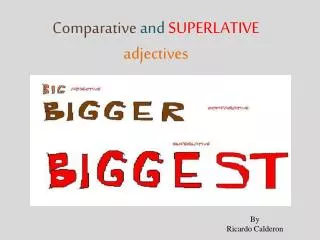
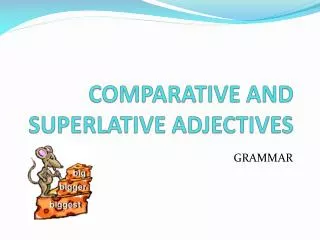
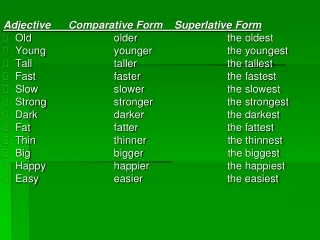
UNIT SUMMARY • In this unit, students will learn how to compare two people, two animals, places according to the types of different adjectives. • Besides, they will be able to make comparison in a group using one syllable, two and more syllable and irregular adjectives.
AIMS • At the end of the unit, students will be able to make up sentences according to the comparative and superlative form.
CURRICULUM-FRAMING QUESTIONS Essential Question • What changed from the past to the present in your life?
CURRICULUM-FRAMING QUESTIONS Unit questions • In what terms can you make comparison? • How can you compare two things? • How can you compare different things in a group?
CURRICULUM-FRAMING QUESTIONS Content questions 1.What are the one syllable adjectives? 2.What are the two and more syllable adjectives? 3.What are the irregular adjectives?
TWENTY-FIRST CENTURY ABILITIES Students will be able to acquire communication skills, basic computer navigation skills. They will enhance their creativity, adaptation and flexibility.
BIBLIOGRAPHY • http://www.eflnet.com/tutorials/adjcompsup.php • http://esl.about.com/od/grammarstructures/p/g_compsup.htm