
SlideServe
Menu
Préférences
© SlideServe · v2026

Comparative and Superlative Degree

inga avatar
8 diapositives · 833 Views · Aug 09, 2014

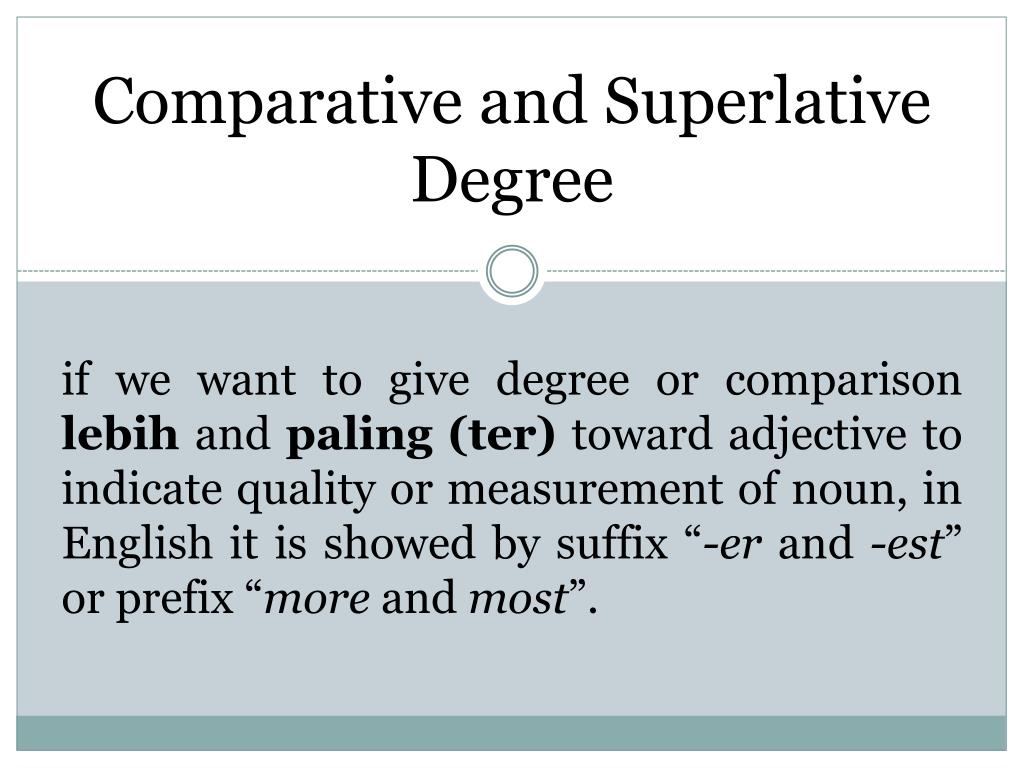
Comparative and Superlative Degree. if we want to give degree or comparison lebih and paling (ter) toward adjective to indicate quality or measurement of noun, in English it is showed by suffix “ -er and -est ” or prefix “ more and most ”. COMPARATIVE DEGREE. I. Comparative Degree
Comparative and Superlative Degree - slide 1
01 / 8Comparative and Superlative Degree
1 / 17

Télécharger la présentation

Comparative and Superlative Degree
Une image / un lien ci-dessous est fourni (tel quel) pour télécharger la présentation

Politique de téléchargement : le contenu du site vous est fourni TEL QUEL pour votre information et votre usage personnel ; il ne peut être vendu, concédé sous licence ni partagé sur d’autres sites sans l’accord de son auteur.Le contenu vous est fourni TEL QUEL, pour votre information et votre usage personnel uniquement. Téléchargez la présentation en cliquant sur ce lien. Lors du téléchargement, si vous ne parvenez pas à télécharger une présentation, l’éditeur a peut-être supprimé le fichier de son serveur.Pendant le téléchargement, si vous ne parvenez pas à obtenir une présentation, le fichier a peut-être été supprimé par l’éditeur.

F I N

Plus de contenu associé

Transcription de la présentation
  1. Comparative and Superlative Degree if we want to give degree or comparison lebih and paling (ter) toward adjective to indicate quality or measurement of noun, in English it is showed by suffix “-er and -est” or prefix “more and most”.

  2. COMPARATIVE DEGREE • I. Comparative Degree • Comparative Degree is used to: • 1. comparing singular noun with the other singular noun • 2. comparing one group of noun with the other group of noun • Formula: • Subject + to be + comp. degree + than + pronoun + to be • Subject + to be + comp. degree + than + noun • For example: • Kamu lebih tinggi dari dia • You are taller than him • Jono tiba lebih lambat dari Bambang • Jono arrived later than Bambang

  3. SUPERLATIVE DEGREE • Superlative degree is used to express “mutlak/paling/ter”. • Formula: • Subject + to be + the + sup. degree • For example: • Saya yang paling muda di keluarga saya • I’m the youngest in my family

  4. Drill: • Hal yang paling penting dalam mencapai kesuksesan • hidup adalah hari ini harus lebih baik dari kemarin • The most important thing in reaching a success of life is • today must be better than yesterday

  5. REGULAR • Adjective with one syllable is showed by “-er and -est” • ex: Comp. Degree Sup. Degree • Short shorter shortest • Black blacker blackest • Attention! • Consonant must be doubled if preceded by single vowel • ex: Fat fatter fattest • Thin thinner thinnest

  6. 2. Adjective with two syllable is also showed by “-er and -est” if : • a. Stress is in the second syllable • Comp. Degree Sup. degree • Polite politer politest • Profound profounder profoundest • b. ended by “y, er, le, ow, some, full ” • lazy lazier laziest • clever cleverer cleverest • able abler ablest • careful carefuler carefulest • handsome handsomer handsomest • Other than the rule above, it uses “more and most” • beautiful more beautiful most beautiful • diligent more diligent most diligent • famous more famous most famous

  7. II. IRREGULAR Comp. degree Sup. degree many more most much more most good better best well better best bad worse worst old older oldest far farther farthest little less least late later latest (time) late latter last (sequence)

  8. Comparative and Superlative Degree in Adverb of manner • Use more and most for Adverb of manner ending in “ly” • ex: - katakan padanya dengan lebih sopan • tell her more politely • Drill: • jawab soal ini dengan lebih cepat • answer this question more quickly