Enhancing Snow-Vegetation Interactions in Land Models
Explore how vegetation influences snow distribution and improve hydrologic estimates through snow-vegetation interactions in land surface models; innovative LiDAR-based modeling for predicting water and energy fluxes in forested areas.

Enhancing Snow-Vegetation Interactions in Land Models
E N D
Presentation Transcript
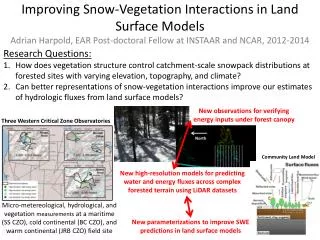
Improving Snow-Vegetation Interactions in Land Surface ModelsAdrian Harpold, EAR Post-doctoral Fellowat INSTAAR and NCAR, 2012-2014 • Research Questions: • How does vegetation structure control catchment-scale snowpack distributions at forested sites with varying elevation, topography, and climate? • Can better representations of snow-vegetation interactions improve our estimates of hydrologic fluxes from land surface models? New observations for verifying energy inputs under forest canopy Three Western Critical Zone Observatories Community Land Model New high-resolution models for predicting water and energy fluxes across complex forested terrain using LiDAR datasets Micro-metereological, hydrological, and vegetation measurements at a maritime (SS CZO), cold continental (BC CZO), and warm continental (JRB CZO) field site New parameterizations to improve SWE predictions in land surface models