Understanding Parallel RLC Circuit Representations and Power Calculations
70 likes | 176 Vues
This guide explores the behavior of a parallel RLC circuit, focusing on phasor representation and the relationship between voltage and current. It explains the roles of resistance (Rt), inductive reactance (XL), and capacitive reactance (XC) in phase relationships, showcasing how the total current can be expressed using polar form. We discuss the calculation of impedance (Zt) using the formula Zt = E/It, along with power calculations such as total power (Pt), reactive power (QT), and apparent power (St). Power triangles are also illustrated to enhance understanding.


Understanding Parallel RLC Circuit Representations and Power Calculations
E N D
Presentation Transcript
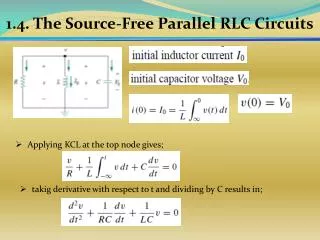
Resistance Rt @ 0 degrees as I is in phase Inductive Reactance XL @ -90 degrees I lags Capacitvie Reactance Xc @ 90 degrees I leads Current Total Formula by use of polar form It = Ir<0 + Ixl<-90 + Ixc<90 It = __ @angle which is the p.f< of the ckt Current In Parallel RLC
Impedance Triangle Cannot be used!! Impedance is only calculate by this formula Zt = E / It Impedance
P.F is found through current calculations Power Total Pt = Pr or Pt = E x Ir x P.F Reacitive Power ( calculate same as series) QXL = E x IXL QXC = E x Ixc Qt = QXL - Qxc Qt=√S²-P² Apparent Power St = Pt@0 + Qt@90 or -90 St= Es x It St - __@ angle – p.f angle same as current angle Power Triangle