Impact of String Type and Length on the Efficiency of Tin Can and Paper Cup Telephones
This project investigates how different types of string and string lengths influence the efficiency of sound transmission in tin can and paper cup telephones. The hypothesis states that shorter string lengths will improve efficiency, as less distance means less time for sound to travel. The experiment uses various materials including paper cups, tin cans, and different string types. Results show that the material of the cup significantly affects sound quality, challenging the hypothesis regarding string materials. This study offers insights into acoustic properties in simple communication devices.

Impact of String Type and Length on the Efficiency of Tin Can and Paper Cup Telephones
E N D
Presentation Transcript
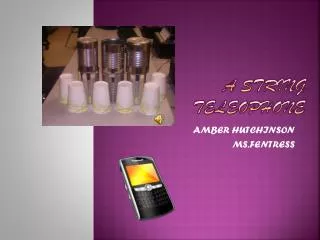
A STRING TELEOPHONE AMBER HUTCHINSON MS.FENTRESS
TABLE OF CONTENTS • TITLE • TABLE OF CONTENTS • QUESTION • HYPOTHESIS • VARIABLES • MATERIAL • PROCEDURES • GRAPH • CONCLUSION • QUESTION? • Bibilography
QUESTION • Do different types of string or string lengths affect the efficiency of a tin can or paper cup telephone?
HYPOTHESIS • I think the different types of string will affect the efficiency of a tin can or paper cup because the shorter length the shorter time.
Variables • Independent sound string and string lengths • Dependent volume • Controlled cups and holes
MATERIALS • Paper cups large • Tin cans medium • Sting 10 ft and 5ft • Twine 10ft and 5ft • Thread 10ft and 5ft • Awl
PROCEDURES • Thread string through cups and cans. • Stretch apart string twine and thread. • Finally talked into cup while some one listened.
CONCLUSION • The paper cup material is what makes the difference in sound not the string material.
QUESTION? • How come you could not hear the tin cans echo but you could hear the paper cups?
BIBLIOGRAPHY • ENCYCLOPEDIA • BOOKS Last,FirstField eneterpriseseducational corporation book • INTERNET • “String Phones” ONLINE: www2.edc.org/sciencequest/2001/SQ0110141/index.htm