Invasive Plants: Impact and Traits
110 likes | 218 Vues
Learn about invasive plants that thrive beyond their natural range, their traits, economic impacts, and common examples like Kudzu, Whitetop, Princess Tree, Japanese Honeysuckle, and Water Hyacinth.


Invasive Plants: Impact and Traits
E N D
Presentation Transcript
Definition • Invasive plants are introduced species that can thrive in areas beyond their natural range of growing. These plants are characteristically adaptable, aggressive, and have a high reproductive capacity. Their vigor combined with a lack of natural enemies often leads to outbreak populations. • Some invasive species are native species that naturally occur in a habitat but are experiencing a population explosion in response to an unnatural influence such as disturbance by humans (dandelions can cause economic harm even where they are native).
Common Traits • Fast growth • Rapid reproduction • High dispersal ability • Phenotypic plasticity (the ability to alter one’s growth form to suit current conditions) • Tolerance of a wide range of environmental conditions • Ability to live off of a wide range of food types • Association with humans[
Impact • Estimated economic impact of invasive species is more than $100 billion dollars each year. • Invasive species impact nearly half of the species currently listed as Threatened or Endangered under the U.S. Federal Endangered Species Act.
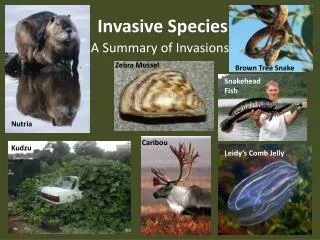
Kudzu • Native to Asia • Introduced in late 1800s for erosion control • Crowds out native species • Currently grows all over the southeastern US
Whitetop • Native to Eurasia • Introduced in early 1900s by accidental seed contamination. • Crowds out native species • Currently grows in Northwestern US
Princess Tree • Native to China • Introduced in 1840 as an ornamental plant • Grows and produces seeds rapidly, and displaces native species in disturbed areas • Currently grows in Eastern, Southeastern and Midwestern US
Japanese Honeysuckle • Native to Asia • Introduced in 1800s as an ornamental plant • Crowds out native species • Grows pretty much everywhere except the Northwestern US
Water Hyacinth • Native to South America • Introduced in 1884 as an ornamental plant • Forms dense colonies that block sunlight, clog water intakes, and crowd out native species • Currently grows in FL, GA, LA, TX, and CA
Some NYS Invasive Species • Black Swallow Wart • Brazilian Water-weed • European Bird Cherry • Kudzu • Floating Primrose Willow • Japanese Black Pine • Japanese Wisteria • Wineberry • Velvet-leaf • Yellow Foxglove • Rambler Rose • Water Chestnut • Marsh Thistle • Cup Plant