Understanding Bernoulli Trials and Binomial Distribution in Coin Flipping
This article explores the concepts of Bernoulli trials and the binomial distribution, focusing on how they apply to coin flipping. It discusses the frequency of outcomes (e.g., 60% heads and 40% tails), the probability of specific sequences, and methods for calculating the average and variance of the total number of heads obtained across multiple flips. Real-life examples and mathematical explanations provide readers with a deeper understanding of how these statistical principles function and their applications.

Understanding Bernoulli Trials and Binomial Distribution in Coin Flipping
E N D
Presentation Transcript
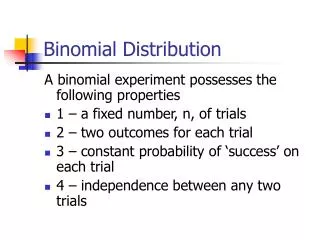
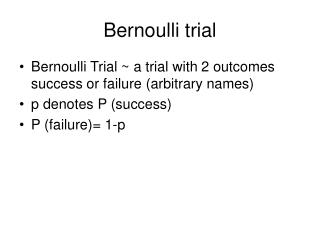
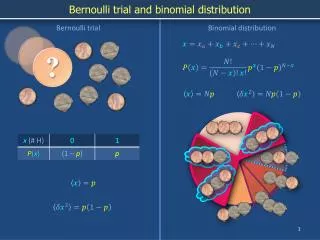
Bernoulli trial and binomial distribution Bernoulli trial Binomial distribution ?
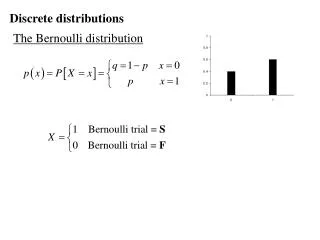
Bernoulli trial ? 60 40 Frequency P 0 1 x (# heads)
Bernoulli trial Average number of heads ? 60 40 Frequency P 0 1 x (# heads)
Bernoulli trial Average number of heads Variance of number of heads ? 60 40 Frequency P 0 1 x (# heads)
Bernoulli trial and binomial distribution Bernoulli trial Binomial distribution ?
Binomial distribution Say, ? ? ?
Binomial distribution Let float Say, ? ? ?
Binomial distribution Total heads across N coin flips Probability of particular sequence ? ? ?
Binomial distribution Total heads across N coin flips Probability of particular sequence ? ? ? Ways to get same # x of total heads x = 2 heads 3 ways N = 3 flips
Binomial distribution Total heads across N coin flips Average total number of heads ? ? ?
Binomial distribution Total heads across N coin flips Average total number of heads Variance of total number of heads ? ? ?