Observation & Inference
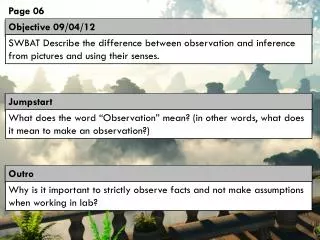
This guide explores the fundamental concepts of observation and inference, essential for scientific inquiry. Observations can be quantitative (measurable) like "3 meters long" or qualitative (descriptive) such as "red flowers." Inference involves drawing conclusions from these observations. For example, if you hear screams and smell cotton candy at a fair, you may infer there's an event happening. By practicing with animal tracks, we can enhance our observational skills and refine our inferential reasoning, critical for scientific exploration.

Observation & Inference
E N D
Presentation Transcript
Observations • Any information collected with the senses. • Quantitative – measureable or countable • 3 meters long • 4 marbles • 50 kilograms • 35 degrees Celsius • Qualitative – describable, not measureable • red flowers • smells like fresh baked cookies • Tastes bitter • The skill of describing scientific events
Inference • Conclusions or deductions based on observations. • The process of drawing a conclusion from given evidence. Practice: • Observations: • I hear people screaming • I smell cotton candy, popcorn, and hamburgers • I see a lot of people • Inference = ?
Look at these two sets of animal tracks. List 3 OBSERVATIONS Make an INFERENCE
Now what do you think? Make 3 OBSERVATIONS Make an INFERENCE
Now what do you think? Make 3 OBSERVATIONS Make an INFERENCE