Understanding Time Series Decomposition: Trend, Seasonal Variation, Cycle, and Irregular Fluctuation
This chapter explores the decomposition method in time series analysis, dividing data into four components: Trend (TRt), Seasonal Variation (SNt), Cycle (CLt), and Irregular Fluctuation (IRt). The trend signifies long-term movements, while seasonal variation relates to yearly cycles. The cycle shows changes over 2 to 10 years, and irregular fluctuations represent non-patterned volatility. It details both additive and multiplicative decomposition models, moving averages, and provides steps for deseasonalizing data and identifying trends and relationships within the data.

Understanding Time Series Decomposition: Trend, Seasonal Variation, Cycle, and Irregular Fluctuation
E N D
Presentation Transcript
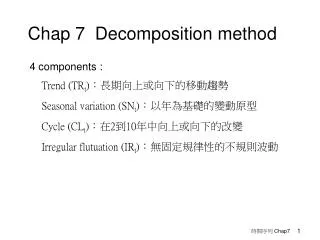
Chap 7 Decomposition method 4 components : Trend (TRt):長期向上或向下的移動趨勢 Seasonal variation (SNt):以年為基礎的變動原型 Cycle (CLt):在2到10年中向上或向下的改變 Irregular flutuation (IRt):無固定規律性的不規則波動
視時序觀察值為此四成因的函數 累積性模式— multiplicative decomposition model 通常表示為累積性或累加性模式: 累加性模式-- additive decomposition model
移動平均法:一種時序平滑法 目的:消除季節變動及不規則震盪,以凸顯時序的走勢或循環變動 • SMA (simple moving average) 使用時間t 及之前的k-1筆資料的平均值作為目前新資料,使用的 k值越大,越平滑 取平均期 = k, SMAt =
CMA (centered moving average) 使用目前及對稱的前後資料,作為目前的新資料 均期=L L為奇數時:CMAt = 如: L=5,股票五日線圖 L為偶數時,執行 2 階段計算 例:L=4,先計算每 4 筆資料的平均,再計算每二筆的平均,得到第 3 筆以後的 CMA 註:使用 CMA ,會失去前後數筆資料,通常用於 focecast時,不使用CMA,而使用 SMA.
累加性模式-- additive decomposition model Step1 CMA of length L,L=# of seasons in a year, 得到CMAt,此步可消除season 及 error成因 Step2 計算Yt - CMAt,得到 SN + IR Step3 計算每季平均值,調整每季節成因,使其和 = 0, 得到 SNi, i=1,… , L Step5 扣除季節成因 (deseasonalize), Step6 由dt資料找出線性或其他關係的 Trend
原資料與CMA 原資料扣除SN 原資料與預測值
累積性模式-- multiplicative decomposition model Step1 CMA of length L,L=# of seasons in a year, 得到CMAt,此步可消除season 及 error成因 Step2 計算Yt / CMAt,得到 SN . IR Step3 計算每季平均值,調整每季節成因,使其積 =1, 得到 SNi, i=1,… , L Step5 扣除季節成因 (deseasonalize), Step6 由dt資料找出線性或其他關係的 Trend