
1 / 4

Understanding Relative Clauses: Usage of Who, Which, Whose, Whom, and That

This guide explains relative clauses and the correct use of relative pronouns such as who, which, whose, whom, and that. Learn how to identify when to use these pronouns as subject or object pronouns for people and things, as well as for expressing possession. The guide includes practical examples illustrating various scenarios, such as combining sentences to form relative clauses. Discover how some relative pronouns can be omitted in certain cases, enhancing your understanding of this essential grammatical structure.
Télécharger la présentation

Understanding Relative Clauses: Usage of Who, Which, Whose, Whom, and That

An Image/Link below is provided (as is) to download presentation Download Policy: Content on the Website is provided to you AS IS for your information and personal use and may not be sold / licensed / shared on other websites without getting consent from its author. Content is provided to you AS IS for your information and personal use only. Download presentation by click this link. While downloading, if for some reason you are not able to download a presentation, the publisher may have deleted the file from their server. During download, if you can't get a presentation, the file might be deleted by the publisher.

E N D

Presentation Transcript


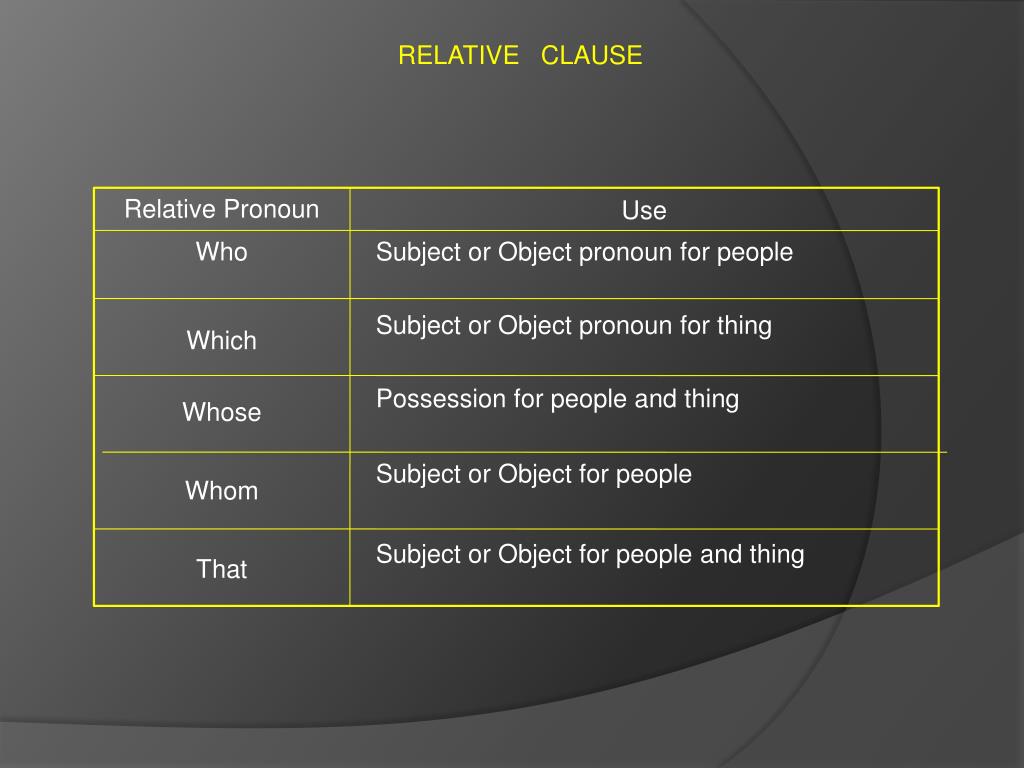
  1. RELATIVE CLAUSE Relative Pronoun Use Who Which Whose Whom That Subject or Object pronoun for people Subject or Object pronoun for thing Possession for people and thing Subject or Object for people Subject or Object for people and thing

  2. Examples: • The teacher is responsible for the computer centre • The teacher has just arrived •  The teacher who is responsible for the computer centre has just arrived • The microprocessor is a chip • The chip processes the information provided by the software •  The microprocessor is a chip which processes the information provided • by the software • That man’s hair is curly • That man is my father •  That man whose curly is my father • He is taught by that teacher • I taught that teacher before •  He is taught by the teacher whom I taught before • I know some information • The information is very crucial •  I know some information that is very crucial

  3. COMPARE! Relative Pronoun can be left out when: 1. They are not the subject of the relative clause e.g. - The computer which we saw at the exhibition runs at 2.5 GHz The computer we saw at the exhibition runs at 2.5 GHz The relative is in progressive form e.g. - Someone who is standing there is my uncle Someone standing there is my uncle The relative is in past participle (passive form) e.g. - I want to see the mosque that was designed by my brother last year I want to see the mosque designed by my brother last year

  4. Translate into English! CPU adalahotaknyakomputer. CPU berfungsiuntukmengeksekusi program danmengkordinasisemuataktifitas-aktifitas unit lainnya  2. Diaadalahseoranganakkecil Diabisaberbicaraempatbahasaasing  Saya tau sebuahrahasia Rahasiainibisamembuatcitrakampusitujatuh.  Sayadiundangolehseorang professor Sayamenemuiprofesoritudi campus duahari yang lalu  Apakahkamukenalseorangdosen? Istrinyaseorangdokter 

More Related